If you're searching for an AtData review or a TowerData review, you probably want to know one thing: is this the right platform for your workflow? The answer depends on what you need it for, because AtData isn't only an email verifier. It describes itself as an email address intelligence platform, with verification sitting alongside identity enrichment and fraud prevention.
That breadth suits teams that need identity and fraud data built around the email address. For B2B teams whose main job is verifying contacts on company domains before outreach, the question is narrower: how many addresses does a tool resolve to a clear valid or invalid result, especially on catch-all domains? You can check how that looks on a single address with our free email verifier.
Below, we cover how AtData relates to TowerData, what the platform does, how pricing works, what users say on G2, where it fits, and which alternatives suit B2B email verification.
Key takeaways
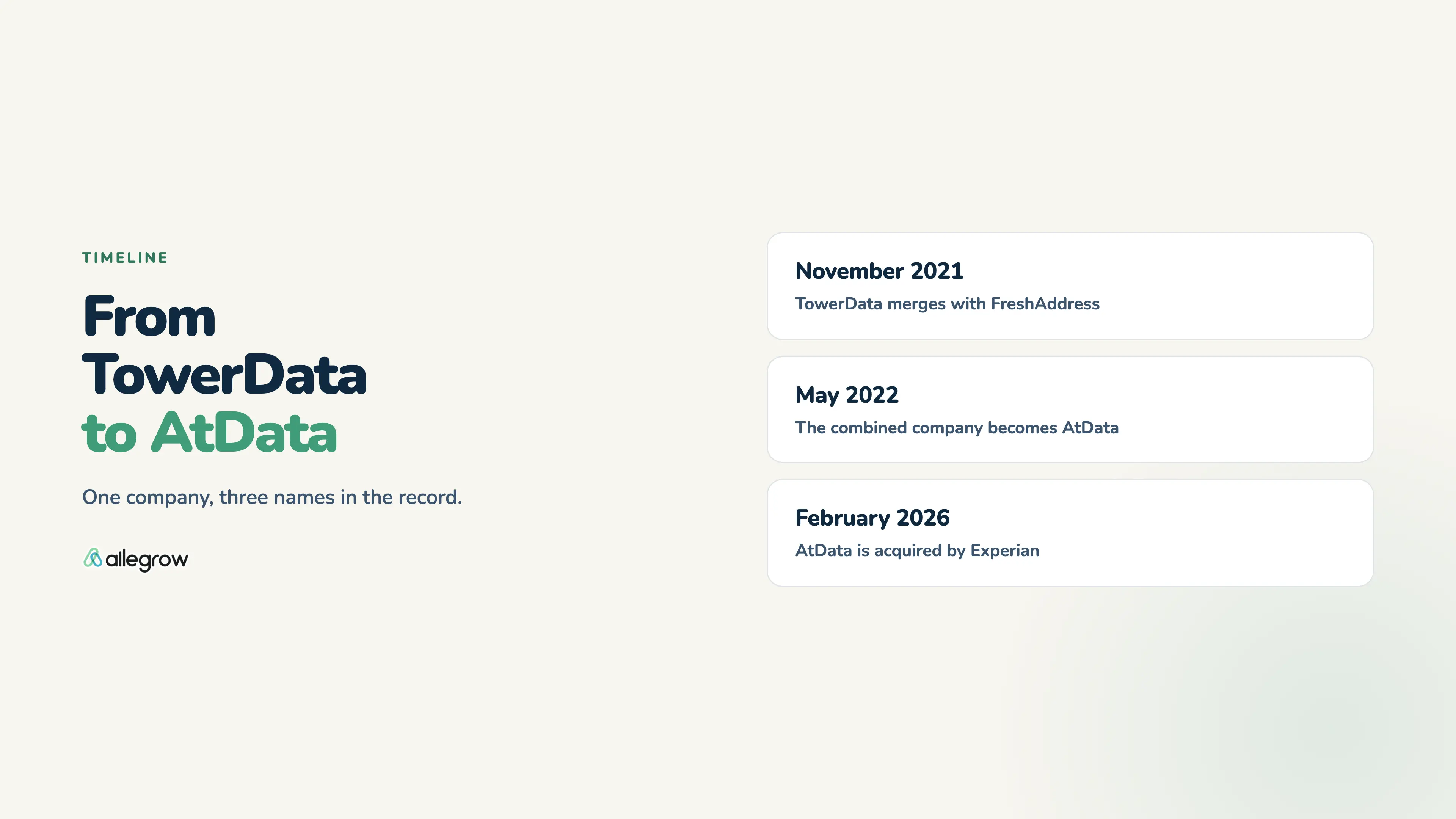
- AtData is TowerData's successor. TowerData and FreshAddress merged in November 2021 and rebranded as AtData in May 2022. Experian acquired AtData in February 2026.
- Verification is one part of a wider platform. AtData also sells identity enrichment, fraud prevention and re-engagement services built on email data.
- Pricing isn't published. AtData's site routes pricing to a sales conversation. G2 lists entry figures from $0.01 per input with a 25,000 minimum batch.
- Users rate it well. AtData holds 4.4 out of 5 on G2 from 26 reviews, with praise for data quality and support and some complaints about onboarding and pricing.
- B2B verification depends on catch-all resolution. In our census of Fortune 500 primary domains, 69% were catch-all, behind a secure email gateway, or both. On lists like that, the share of contacts a tool can resolve matters more than platform breadth.
Is AtData the same as TowerData?
In practical terms, AtData is the current version of TowerData. After merging with FreshAddress, the company rebranded as AtData, and its positioning also evolved. Rather than focusing only on email verification, AtData now presents itself as a broader email address intelligence platform that supports identity enrichment, fraud prevention, audience activation, and list hygiene workflows alongside verification.
For buyers researching the market today, that distinction matters because older reviews, integrations, and documentation may still reference TowerData even though the products now operate under the AtData brand. So people searching for a TowerData review today should evaluate the current AtData platform rather than looking for a separate TowerData product.
What happened to TowerData?
TowerData merged with FreshAddress in November 2021 and adopted the AtData brand in May 2022. Following the merger, the company shifted its messaging toward the idea that an email address functions as a persistent identity signal across customer data ecosystems.
The combined business expanded beyond email verification into fraud detection, identity enrichment, re-engagement services and continuous list monitoring. In February 2026, Experian acquired AtData, adding its email data to Experian's identity and fraud products. The acquisition may shape AtData's pricing, roadmap and integrations over time, so buyers should confirm current terms directly.
Why does the TowerData name still matter?
Even though the company rebranded to AtData, the TowerData name still appears across older contracts, integrations, help documentation, blog posts, and third-party reviews. Many long-time users and industry discussions continue to reference TowerData because the brand was established in the email data market for years before the transition.
That creates a practical challenge for buyers doing research today. Someone searching for “TowerData pricing” is often evaluating AtData’s current products without realizing the company now operates under a different name. In the same way, buyers researching “AtData email verification” may encounter older TowerData reviews, API discussions, or integration references that predate the rebrand but still describe related services.
For that reason, this article evaluates AtData’s modern platform while referencing both names, rather than treating the old TowerData brand as a completely separate product.
What is AtData and who is it best for?
AtData is an email address intelligence platform that combines email verification with identity enrichment, fraud prevention, list monitoring, and reengagement capabilities. Rather than positioning itself as a lightweight verifier, the company focuses on helping organizations use email addresses as a broader source of customer identity and data intelligence.
Depending on the buyer, that broader scope can either be a major advantage or unnecessary complexity. Enterprise organizations managing millions of customer records may value having multiple workflows connected inside one platform. On the other hand, sales teams or data providers focused specifically on accurate B2B email verification may prefer a more specialized workflow centered on verification depth, catch-all resolution, and clearer valid or invalid outcomes.
This matters most for B2B teams verifying contacts on company domains. Many corporate mail systems are set up as catch-all or sit behind a secure email gateway, and on those domains a basic SMTP check often can't confirm whether a specific mailbox exists. Teams in that position usually care less about identity tooling and more about how many records come back as a clear valid or invalid result.
Who tends to choose AtData?
AtData tends to be best suited for enterprise and mid-market organizations managing large databases and more complicated customer data environments. Typical buyers often include:
- Marketing teams focused on large-scale list hygiene
- Identity and enrichment teams
- Fraud prevention teams
- Data licensing businesses
- Organizations running procurement-driven buying processes
AtData fits teams that want identity intelligence, enrichment, fraud scoring and long-term data management under one contract. A sales team verifying contacts before outreach has a narrower job, and usually looks for a tool built around catch-all resolution and scalable API-driven verification.
What can AtData actually do?
AtData's platform covers five areas. Email verification validates addresses, corrects formatting errors and flags risky contacts. Identity enrichment adds demographic and contact data to email addresses for segmentation, and fraud prevention uses email signals and behavior to flag suspicious sign-ups.
List monitoring checks database quality continuously rather than in one-off cleans, and re-engagement services help win back inactive customers. Verification is also available through batch processing and a self-service portal. In practice, AtData works as an email intelligence platform with verification as one part of it.
Furthermore, list monitoring helps organizations continuously monitor email database quality rather than relying only on periodic cleaning, while reengagement workflows support inactive customer recovery and audience expansion efforts.
Lastly, self-service verification workflows are also available through batch processing and portal-based tools. The important takeaway is that AtData functions more like an email intelligence ecosystem than a simple verification utility.
How much does AtData cost?
AtData doesn't publish pricing on its own site; its pricing page routes to a sales contact form. G2 lists these entry figures:
- Free trial: 100 verifications
- Batch validation: from $0.01 per input, with a minimum batch of 25,000
- Monthly subscriptions: from around $100
At $0.01 per input, the 25,000 minimum puts the smallest batch at about $250. Larger volumes, licensing and add-on services are quoted directly, so confirm current rates with AtData before you buy.
For most buyers, the bigger difference is the buying process. A procurement-led contract suits a large organization. A GTM team cleaning its CRM usually wants to test, connect an API and scale without a sales cycle.
What are the pros and cons of AtData?
The strengths and limitations below come from G2 reviews and from what the platform is built to do. Which ones matter depends on whether your priority is verification or wider identity and fraud work.
What does AtData do well?
G2 reviews consistently mention data quality, email verification, deliverability gains, ease of use and responsive support. Users often describe cleaner databases and fewer bounces after adopting the platform.
Several reviewers also point to better list quality and engagement, and some single out its fraud analytics and SMTP-level insights as useful extras.
Where does AtData fall short for email verification buyers?
While users highlight several positive aspects of AtData on G2, several recurring limitations also appear, especially when viewed through an email verification buyer's lens.
Some users mention interface navigation confusion during initial onboarding. That may sound minor, but onboarding friction often translates into slower evaluation cycles and reduced adoption. Additionally, pricing can also feel enterprise-oriented. Teams wanting immediate deployment and transparent scaling may encounter additional procurement steps.
Last but not least, the broad platform scope itself can also create unnecessary complexity. For example, a sales team verifying executive contacts before outbound campaigns may not need enrichment layers, fraud intelligence, and adjacent services bundled into the buying process.
What do real users say about AtData?
Customer reviews often provide a useful reality check because they show how a platform performs outside of product pages and sales conversations. In AtData's case, the overall sentiment appears positive. At the time of writing, AtData holds a 4.4 out of 5 rating on G2, based on 26 reviews.
While the sample size is relatively modest for a company that has been operating in the email data space for many years, the reviews provide useful insight into how customers experience the platform. The recurring themes suggest that users generally view AtData as a capable solution for email data quality and list hygiene. However, certain aspects of the product experience receive more mixed feedback.
What do positive AtData reviews usually highlight?
Positive reviews frequently focus on AtData's ability to improve data quality and support email deliverability initiatives. Many users describe the platform as helping them maintain cleaner databases, reduce bounce rates, and improve the overall performance of their email programs.
Another recurring theme is the value of AtData's broader intelligence capabilities. Rather than acting as a simple one-time verification tool, several reviewers describe the platform as helping them continuously manage and improve database quality over time. Users also highlight fraud insights, email activity intelligence, and the ability to make better decisions based on additional data associated with email addresses.
Customer support is another area that receives regular praise. Multiple reviewers mention responsive support teams and helpful guidance during implementation and ongoing use. For organizations managing large email databases, that level of support can be particularly valuable when integrating verification and data-quality processes into existing workflows.
What complaints appear in AtData reviews?
The most common criticisms are not necessarily about verification accuracy, but about usability and buying experience. Some reviewers mention that certain parts of the interface can feel confusing when first getting started, creating a learning curve during onboarding.
Pricing is another recurring discussion point. Several users note that AtData's pricing structure can feel more enterprise-oriented than some competing verification tools. While reviewers generally acknowledge the value provided by the platform, smaller teams may find the procurement process or pricing model less straightforward than highly self-service alternatives.
A smaller number of reviews also mention mixed support experiences, although this is not a dominant theme across the review base. Taken together, these concerns are not major red flags, but they become more relevant for buyers whose primary goal is fast deployment, simple workflows, and specialized email verification rather than broader email intelligence capabilities.
Why do people look for an AtData or TowerData alternative?
Most buyers who explore AtData alternatives are not necessarily unhappy with the platform. Instead, they are often evaluating whether a different tool is better aligned with their specific workflow requirements.
In many cases, the search for an alternative begins when buyers want a more focused verification experience. Some organizations need faster self-service onboarding, while others prioritize verification APIs designed specifically for B2B data environments. Teams may also look for stronger handling of catch-all domains, clearer valid-versus-invalid outcomes, or more confidence on contacts behind corporate mail security.
These requirements are particularly common among data providers, GTM teams, and organizations that depend on large volumes of outbound communication. For these buyers, verification is not simply a data-cleaning exercise. It directly influences deliverability, campaign performance, and revenue generation.
The difficulty is structural. Many company domains are set up as catch-all, accepting mail for any address, for operational reasons such as aliases, acquired brands and legacy routing. Many also sit behind a secure email gateway that accepts mail first and filters it afterward. In our census of all 500 Fortune 500 primary domains, 47% ran a catch-all domain and 69% were catch-all, gateway-fronted or both, with Proofpoint fronting 80% of the gateways. On those domains a basic SMTP check gets the same "accept" for a real employee and an invented name, so many tools return unknown or accept-all. Those results aren't wrong, but a sales team still has to decide whether to send to them or suppress them.
As a result, many buyers evaluating AtData alternatives are ultimately searching for more decisive verification workflows rather than broader data intelligence capabilities.
What are the best AtData alternatives?
The best AtData alternative depends on what problem you are actually trying to solve. If your priority is broader email intelligence, identity enrichment, or fraud prevention, AtData remains a strong contender. However, buyers focused primarily on B2B email verification often evaluate more specialized options that prioritize verification accuracy and decision-making confidence. With that in mind, let’s take a closer look at some of the best AtData alternatives on the market.
Allegrow: The best AtData alternative for B2B email verification
While AtData offers a broad platform, Allegrow is purpose-built for organizations that need highly accurate B2B email verification. The difference is not simply the number of features available. It is the depth of verification and the ability to produce actionable outcomes when traditional verification methods reach their limits.
Allegrow uses a multi-layered verification approach that combines syntax validation, SMTP and MX verification, and proprietary signals developed specifically for B2B environments. This allows the platform to move beyond basic mailbox checks and produce more reliable verification decisions across complex business domains.
One of the most significant challenges in modern verification is the prevalence of catch-all domains and secure email gateways. Many verification providers respond by returning large numbers of “unknown” results, leaving users to make judgment calls themselves. Allegrow takes a different approach by using additional verification signals to classify more records as either valid or invalid, creating clearer outcomes for operational teams.
In our 10,000-email benchmark of 11 tools on catch-all domains in August 2026, Allegrow found 491 of 500 real people (98.2%), the most of any tool tested. It called 11 of 5,000 invented addresses valid (0.22%) and left 2.0% of records unresolved. AtData wasn't part of that test, so treat these figures as a reference point and run your own list through both tools.
For teams already sending, Allegrow's Safety Net works inside Outreach, Salesloft, Apollo and HubSpot, checking contacts before a sequence step sends. Pricing starts at $99 a month for 5,000 contacts, and Allegrow offers unlimited plans for high-volume teams.
Kickbox
Kickbox is one of the more established names in the email verification market and takes a more focused approach than AtData. The platform centers primarily on email verification workflows rather than broader identity intelligence or fraud-prevention capabilities.
Its public documentation highlights API-driven verification and result categories such as deliverable, undeliverable, risky, and unknown. For many organizations running standard verification workflows, that level of functionality may be sufficient to maintain list quality and reduce bounce rates.
However, buyers working heavily with enterprise contact data, catch-all domains, or protected mail environments may find themselves wanting more conclusive outcomes. In those situations, specialized B2B verification platforms may provide greater confidence and fewer unresolved records.
Clearout
Clearout positions itself as more than a verification tool by combining email validation with adjacent capabilities such as email finding, prospecting workflows, bulk verification, form protection, and API integrations.
This broader feature set can be attractive for teams that want multiple lead-generation and data-quality workflows inside a single platform. Organizations that regularly switch between prospecting, enrichment, and verification tasks may appreciate the convenience of having those functions connected.
The trade-off is that buyers seeking the deepest possible B2B verification capabilities may still prioritize verification accuracy over workflow breadth. For those organizations, factors such as catch-all resolution, enterprise-contact verification, and reducing unknown outcomes often become more important than having additional prospecting features bundled into the platform.
Is AtData right for B2B email verification?
AtData is a credible email intelligence platform, now backed by Experian, with positive G2 reviews and a wider scope than most verifiers. That scope pays off when you need identity enrichment, fraud prevention and list hygiene from one provider.
When the job is verifying B2B contacts before outreach, the criteria change. What matters is how many contacts on catch-all and gateway-fronted domains come back as a clear valid or invalid result. Allegrow is built for exactly that: it resolves catch-all addresses at the mailbox level, so more of a corporate list can be emailed with confidence and fewer real prospects get suppressed.
If you're evaluating AtData, test a B2B-focused verifier on your own data first. Start a 14-day free trial and run up to 1,000 of your contacts through Allegrow, including the catch-all addresses your current tool can't confirm, then compare the results side by side.
Frequently asked questions about AtData and TowerData
Is AtData the same as TowerData?
Yes. AtData is the brand TowerData and FreshAddress adopted in May 2022, after merging in November 2021. Experian acquired AtData in February 2026, so it now sits within Experian's identity and fraud business. Older contracts, documentation and reviews may still say TowerData, but they refer to what is now AtData.
What does AtData do?
AtData is an email address intelligence platform. It combines email verification with identity enrichment, fraud prevention, list monitoring and re-engagement services, all built around the email address as an identity signal. Teams use it for list hygiene, customer data enrichment and screening risky sign-ups, through APIs, batch processing and a self-service portal.
Is AtData mainly an email verification tool?
No. Email verification is one part of AtData, alongside identity enrichment, fraud prevention and re-engagement services, which makes it a wider purchase than a standalone verifier. This review focuses on verification because that's where most B2B buyers compare AtData with specialized tools like Allegrow.
Is AtData good for email verification?
AtData is a solid choice for general list hygiene, and G2 users rate it 4.4 out of 5. For B2B lists heavy in catch-all and gateway-fronted domains, test it on your own contacts first, because the share of records a tool resolves to valid or invalid varies widely on those domains.
What is the best AtData alternative for B2B email verification?
For B2B email verification, Allegrow is the strongest AtData alternative. It resolves catch-all addresses to valid or invalid at the mailbox level, found 491 of 500 real people in our 10,000-email benchmark, and works inside Outreach, Salesloft, Apollo and HubSpot through its Safety Net. You can test it free on 1,000 contacts.