Apollo's seat prices are easy to find. What's hard to predict is the bill, because it depends on how many credits each action uses, which actions are charged at all, and how many seats the plan requires.
Apollo has a free plan and three paid plans, priced at $49, $79 and $119 per seat a month billed annually. Basic and Professional can also be billed monthly, at $65 and $99, while Organization is annual only, with a three-seat minimum. Every plan comes with a credit allowance shared across the team: an email costs 1 credit, a phone number costs 8, and unused credits expire at the end of each billing cycle.
In this guide, we'll break down each plan, how Apollo's credit system works, what the free plan includes and how API pricing works. We'll then cover the costs the pricing page leaves out, work through real costs for typical team sizes, and look at whether Apollo's pricing is good value once every contact is verified before it's sent to.
Key takeaways
- Apollo's paid plans cost $49, $79 and $119 per seat a month, billed annually. Basic and Professional are $65 and $99 billed monthly. Organization is annual only, with a three-seat minimum.
- Credits are pooled across the team and don't roll over. An email costs 1 credit and a phone number 8, and waterfall sources charge for every result they return, verified or not.
- Catch-all emails cost a full credit, and refunds are narrow. Bounce refunds apply only to verified emails sent from inside Apollo within 30 days, and never to phone numbers.
- Keeping data fresh is a recurring cost. Re-verifying or refreshing a contact costs a credit each time, and that upkeep is often what pushes a team up a plan.
- Many pricing guides still describe Apollo's old model, with "unlimited" email credits and export credits that no longer reflect how the pricing page works.
Apollo.io pricing plans in 2026
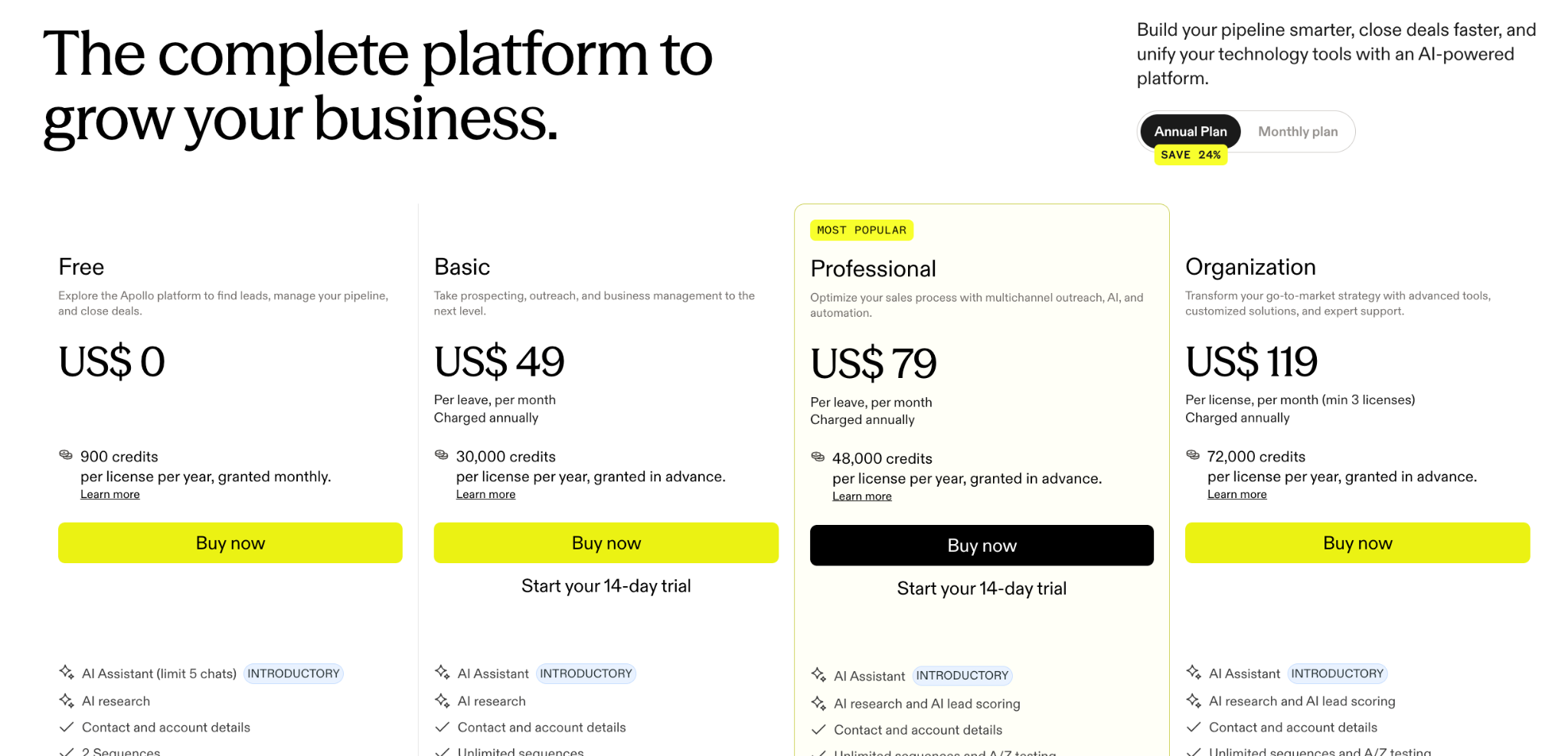
Apollo sells four self-serve plans, plus a Custom plan quoted by its sales team. Every paid plan is priced per seat, and every seat comes with a credit allowance that the whole team shares. The figures below are from Apollo’s pricing page as of October 2026.
Two details sit outside the table:
- Monthly billing grants credits monthly. Basic gets 2,500 a month and Professional 4,000, instead of the whole year upfront.
- "Unlimited" features have a limit. Apollo's pricing FAQ says they're still subject to its fair use policy.
Apollo also sells add-ons, priced per team rather than per seat. Apollo labels this pricing introductory, so it may change.
Annual or monthly billing?
Annual billing is cheaper. Apollo's toggle advertises a 24% saving, which works out to about 25% on Basic ($49 against 65)andabout20%onProfessional(79 against $99). Annual billing also unlocks the whole year's credits on day one, and it's the only option on Organization.
Monthly billing is more flexible. It costs more per credit (about $0.026 on Basic, against about $0.020 on annual billing), but you can cancel at the end of any month.
The catch with annual billing is how hard it is to change. According to Apollo's Terms:
- Fees are non-refundable, and they're "based on the credits purchased, not actual usage."
- Seats can't be reduced during the term.
- Stopping renewal takes written notice at least 30 days before the term ends.
Apollo's pricing FAQ adds that an annual plan can't be switched to monthly mid-cycle.
Which Apollo plan fits your team?
- Free: for testing the data. Good for checking Apollo's coverage on a small sample before buying. The limit to watch is 75 credits a month and two sequences per team, which won't support real outbound.
- Basic: for small, email-first teams. At $1,764 a year for three seats, it covers steady email prospecting with unlimited sequences. The limits to watch are one mailbox per user and 250 sends a day, and phone numbers drain its 30,000 credits per seat quickly.
- Professional: for full-time SDR teams that call as well as email. It adds unlimited Google and Microsoft mailboxes, unlimited daily sends, A/Z testing, AI lead scoring and 4,000 minutes of call recording, at $2,844 a year for three seats. The limit to watch is that every seat must move up together.
- Organization: for larger teams with heavier workflows. It adds 12 intent topics, 500 workflows per team, a 10,000-record selection limit and unlimited inbound routers. The limit to watch is the floor: annual billing only, with three seats minimum, so $4,284 a year at the smallest.
- Custom: for teams that need SSO, advanced security or dedicated support, or volumes the self-serve plans don't cover. Pricing is by quote.
How Apollo's credit system works
Seat prices set the floor. Credits decide the bill. Every paid plan draws on one pooled balance, and each action has its own price in credits, set out on Apollo's credits page and in its help center:
Credits also pay for email infrastructure (domains, mailboxes and warm-up), website visitor identification, form enrichment and CRM or CSV enrichment, according to Apollo's credit usage guide. API costs are covered in their own section below.
How the shared balance works
- Pooled across the team. Credits are granted at the start of each billing cycle, and admins can set per-user limits so one rep can't drain the balance.
- No rollover. Unused credits expire at the end of the cycle, including add-on credits you paid for.
- Add-ons renew automatically. Add-on credits are charged immediately and recur every cycle until you remove them. Apollo doesn't publish a price per add-on credit; you see it in the app before you buy.
- Only net-new contacts are charged. Revealing someone your team already has costs nothing.
What a credit buys on a catch-all address
Apollo states that "you're only charged credits for email addresses that Apollo can verify," and that includes catch-all addresses. Its email status guide defines a catch-all email as one on a domain that accepts messages "even when the individual address might not exist," and charges 1 credit for it, the same as a verified email.
Waterfall enrichment adds a second case. According to Apollo's waterfall guide, each third-party source charges when it returns an email or phone number, "whether or not it's verified," and catch-all addresses can come back too if your settings allow them.
Catch-all configurations are common on corporate domains, so on a B2B list a real share of credits goes to addresses whose mailbox hasn't been confirmed. Verifying those addresses before the first send is where a tool like Allegrow fits: it returns a conclusive valid or invalid result on catch-all addresses, so a team knows which ones are safe to email.
Bounce refunds
Apollo refunds some bounces, under narrow conditions. According to its data request guide, the email must be Apollo-verified, sent from inside Apollo, and bounce within 30 days of being revealed. The credit comes back in the next billing cycle. Bounces from mail sent through other tools aren't covered, and credits for mobile numbers are never refunded.
Phone number credits
A phone number costs 8 credits, the same for every verified number, whether it's a mobile, a direct line or an office extension. On Basic billed annually, a credit costs about $0.02, so a phone number costs about $0.16, against about $0.02 for an email.
That's why phone numbers move teams between plans faster than emails do. 500 numbers a month uses 48,000 credits a year, the entire annual allowance of one Professional seat. Numbers from waterfall sources typically cost more per provider, and phone credits are never refunded.
What changed from Apollo's old credit model
Many guides still describe an older Apollo model:
- "Unlimited" email credits, capped by a fair-use formula.
- Separate export credits for moving contacts out of Apollo.
- $0.20 overage credits, and a monthly Basic price of $59.
Today, Apollo's credits page prices an email at 1 credit from the same pooled balance as everything else, and its credit usage guide says export credits "may only apply to certain plans or legacy configurations." If a guide quotes the figures above, it's describing pricing Apollo no longer shows.
Apollo's free plan: what 75 credits a month gets you
Apollo's free plan grants 900 credits a year, released as 75 a month. That's 75 emails, or about nine phone numbers, and unused credits expire at the end of each month. The plan includes:
- 1 mailbox, Gmail only (Microsoft and other providers need a paid plan)
- 250 email sends a day
- 2 sequences per team
- A record selection limit of 25
- 5,000 AI writing words a month and five AI assistant chats
- API access at Apollo's lowest rate limits (600 general requests a day)
There's also a limit on team size. According to Apollo's plan management guide, free plans are "limited to one seat after one hundred days of active use." Teams that start a 14-day trial of Basic or Professional get 75 credits for the trial, and if they don't upgrade, Apollo moves them to its free Starter plan, which has no time limit.
In practice, the free plan is for testing Apollo's data on a small sample before you buy, not for running outbound. 75 emails a month covers a few days of one rep's prospecting, and two sequences across the whole team won't support a real campaign.
Apollo API pricing
Apollo's API doesn't have its own price. It draws on the same credit balance as the app, and only a few endpoints cost anything. According to Apollo's API pricing documentation:
- People enrichment costs 1 to 9 credits per person: 1 credit for demographics or an email, plus 8 more if a mobile number is returned. Apollo charges only when it finds credit-consuming data, and bulk enrichment takes up to 10 people per request at the same rate.
- Organization search costs 1 credit per page of up to 100 results.
- Every other endpoint is free, including those that create, update, list or manage records.
What separates the plans is how much you can call the API. Apollo's rate limits are:
These limits apply per team, not per API key or per user, so every key and user in a workspace shares them. A high enrichment limit doesn't mean unlimited enrichment, though: each call still spends credits, so the shared balance is usually the real constraint. For more advanced or custom integrations, Apollo's pricing FAQ points teams to the Custom plan.
Apollo's hidden costs and gotchas
The pricing page shows seat prices and credit allowances. These are the rules that change the final bill:
- Unused credits disappear. Credits expire at the end of every billing cycle, including add-on credits you paid for, so buying more than you'll use is money lost.
- Add-on credits renew automatically. They're charged immediately and recur every cycle until you move the slider back to zero, and Apollo doesn't publish a price per add-on credit.
- One plan for the whole team. Every seat on an account has to be on the same plan, so the rep who needs Professional sets the price for everyone.
- Organization has a floor. It's billed annually only, with a three-seat minimum, so the smallest Organization plan costs $4,284 a year.
- Annual plans are hard to shrink. Fees are non-refundable and based on credits purchased, not credits used. Seats can't be reduced during the term, and stopping renewal takes written notice 30 days before the term ends.
- Downgrades don't refund anything. They take effect immediately, with no refund for the unused part of the cycle.
- Waterfall results aren't always verified. Third-party sources charge whenever they return an email or phone number, verified or not, and an optional validator charges again for each result it checks.
- Catch-all emails cost a full credit. Apollo charges 1 credit for a catch-all email, the same as a verified one, even though it defines catch-all domains as accepting mail for addresses that might not exist.
- Refunds are narrow. Only Apollo-verified emails that bounce within 30 days, sent from inside Apollo, are refunded. Phone credits never are.
- Keeping data fresh costs credits. Each "Update required" refresh or re-verification costs 1 credit, and Apollo doesn't offer the same bounce guarantee for verified emails older than six months.
Why Apollo's built-in verification isn't enough for B2B lists
Apollo verifies emails before it charges for them, and for many lists that's enough. For outbound into company domains, though, Apollo's own documentation points to four gaps, and each one lands on the team's sending domain rather than on Apollo's bill.
A verified email is a point-in-time result
Apollo's verification guide states a "91% accuracy rate" for verified emails and describes the remaining 9% as a bounce rate. Its own bounce guidance sets an acceptable bounce rate at under 2%, and says anything consistently above 5% should be investigated.
The protection around that figure is also limited. Refunds only cover bounces sent from inside Apollo within 30 days, and verified emails older than six months don't carry the same guarantee. Therefore, the gap between the 9% and the 2% is the team's to close, and it widens as contacts age.
Catch-all addresses cost a full credit without a confirmed mailbox
Apollo charges 1 credit for a catch-all email, the same as a verified one, and defines a catch-all domain as one that accepts mail "even when the individual address might not exist." Catch-all addresses aren't an edge case on B2B lists: in our census of all 500 Fortune 500 primary domains (validations run April to June 2026), 69% were catch-all, behind a secure email gateway, or both, at the top end of a pattern common across corporate domains.
That makes catch-all contacts both a risk and an opportunity. Sent to blind, they bounce later or vanish without a bounce. Skipped, they take some of a team's most valuable accounts off the list, and because many verifiers return "unknown" on them, those buyers are often less contacted than everyone else.
Waterfall results can come back unverified
When Apollo doesn't have an email, waterfall enrichment checks third-party sources, and each source charges when it returns a result, "whether or not it's verified." An optional validator charges again for each result it checks, and catch-all addresses can come back too if your settings allow them. A team that relies on waterfall to fill gaps can pay twice for a contact and still end up with an address nobody has confirmed.
Re-verifying inside Apollo spends prospecting credits
Every re-verification or "Update required" refresh costs 1 credit from the same pool used to reveal new contacts. For a ten-rep team re-checking 20,000 CRM contacts each quarter, that's 80,000 credits a year, enough to push it from Basic (5,880 a year) to Professional (9,480). Upkeep competes directly with prospecting for the same balance.
Where Allegrow fits alongside Apollo
Apollo's data is a strong starting point, and a separate verification step before the first send closes the gaps above. Allegrow covers that step:
- Conclusive results on catch-all and gateway-fronted company domains, where other tools return "unknown", so catch-all contacts can be emailed or dropped with confidence.
- A check inside Apollo sequences: the Safety Net checks each contact as it's added to a sequence and removes unsafe ones before the first email goes out.
- Re-verification without spending Apollo credits, so the credits upkeep would use go to new prospects instead. Apollo's "Update required" refresh is still the way to find the new address of someone who changed jobs.
A practical cadence is to verify before every new sequence, and to re-verify CRM contacts at least quarterly. To check a single address first, our free email verifier works without signup.
Is Apollo’s pricing good value?
For most outbound teams, yes, as a source of prospects. The thing to plan for is what a revealed email does and doesn’t guarantee.
Where Apollo is strong value
- Cheap per contact: about $0.02 per email on annual billing.
- One tool instead of several: sequencing, dialing, AI writing and CRM sync are included in the same seat.
- Low entry point: a single Basic seat at $49 a month covers what used to take a data provider, a sequencing tool and a dialer.
What Apollo’s own figures say about accuracy
- 91% accuracy for verified emails, with the remaining 9% described as a bounce rate, according to Apollo’s verification guide.
- Under 2% is what Apollo calls an acceptable bounce rate, and anything consistently above 5% should be investigated.
- Catch-all emails cost a full credit, even though Apollo defines them as addresses that might not exist.
- Refunds are limited to bounces sent from inside Apollo within 30 days, and the guarantee weakens after six months.
Catch-all addresses aren’t an edge case on B2B lists. In our census of all 500 Fortune 500 primary domains (validations run April to June 2026), 69% were catch-all, behind a secure email gateway, or both. That’s the top end of a pattern common across corporate domains, and it’s why any database’s “verified” status is a point-in-time claim.
Where a verification step fits
Apollo’s data is a strong starting point. A separate verification step before the first send is what closes the gap between the 9% Apollo’s figures leave open and the 2% it recommends. Allegrow covers that step:
- Conclusive results on catch-all and gateway-fronted company domains, where other tools return “unknown”.
- A check inside Apollo sequences: the Safety Net checks each contact as it’s added and removes unsafe ones before the first email goes out.
- Re-verification without spending Apollo credits, so refresh costs don’t push the team up a plan.
The pairing example above shows what this costs for real team sizes.
Conclusion
Apollo's pricing comes down to three paid plans drawing on one pooled credit balance that resets every cycle and never rolls over. An email costs 1 credit, a catch-all email costs the same, and a phone number costs 8. Basic and Professional can be billed monthly or annually, while Organization is annual only, with a three-seat minimum.
The practical lesson is to choose the plan by credits, not by seats. Count phone numbers and data upkeep in the estimate, not just new emails, because those are what push teams up a plan. And budget for verifying every revealed contact before it's sent to: a catch-all or ageing address costs a credit either way, and a bounce costs the domain.
To see how your Apollo data holds up, start a 14-day free trial and run up to 1,000 contacts revealed from Apollo through Allegrow, including the catch-all addresses, before your next sequence. You'll see how many come back with a conclusive valid or invalid result, on the corporate domains Apollo and other verifiers return "catch-all".
Frequently asked questions about Apollo.io pricing
Does Apollo offer discounts?
Apollo’s main discount is annual billing, which its pricing page advertises as a 24% saving over monthly billing (about 25% on Basic and 20% on Professional). Larger teams can negotiate a Custom plan with Apollo’s sales team. Apollo publishes no other standing discount, so check the pricing page for current offers before you buy.
How do you cancel Apollo, and can you get a refund?
Cancellations take effect at the end of your current plan term, and payments are non-refundable, including for unused credits or time. On annual plans, stopping automatic renewal requires written notice at least 30 days before the term ends. Downgrades apply immediately, with no refund for the rest of the cycle.
Can different users be on different Apollo plans?
No. Every seat on an Apollo account must be on the same plan, so you can’t put some reps on Professional and others on Basic. Apollo recommends choosing the plan that fits your most demanding users, which means one power user can set the price for the whole team.
What happens when you run out of Apollo credits?
Credit-based actions such as revealing emails, mobile numbers and enrichment pause until your next billing cycle, unless an admin buys add-on credits. Add-on credits are charged immediately and renew every cycle until removed. Unused credits, including add-ons, don’t carry over to the next cycle.
How much does Apollo’s AI cost?
Apollo’s AI features are bundled into the seat price, with usage limits by plan. AI writing allows 5,000 words a month on Free, up to 1,000,000 on Organization. AI research costs 1 credit per run. AI lead scoring is available only on Professional and Organization, and Apollo labels its AI assistant pricing introductory.
Do Apollo credits roll over?
No. Unused credits expire at the end of each billing cycle and don't carry over to the next one or to a renewal. That applies to the credits included in your plan and to add-on credits you bought, so it pays to size your plan to the credits your team will actually use.
Does Apollo's free plan give 75 credits every month?
Yes. The free plan includes 900 credits a year, released as 75 at the start of each month, and unused credits expire at the end of that month. That covers 75 emails or about nine phone numbers. Free plans are limited to one seat after 100 days of active use.
Does Apollo have a free trial?
Yes. Teams on the free plan can start a 14-day trial of Basic or Professional, which includes 75 credits and most of the plan's features. If you don't upgrade when the trial ends, Apollo moves you to its free Starter plan, which has no time limit.