Clearout has built its reputation on bundling an email finder, a verifier, and a prospector into a single subscription for a reasonable price (~$58 for 10,000 credits).
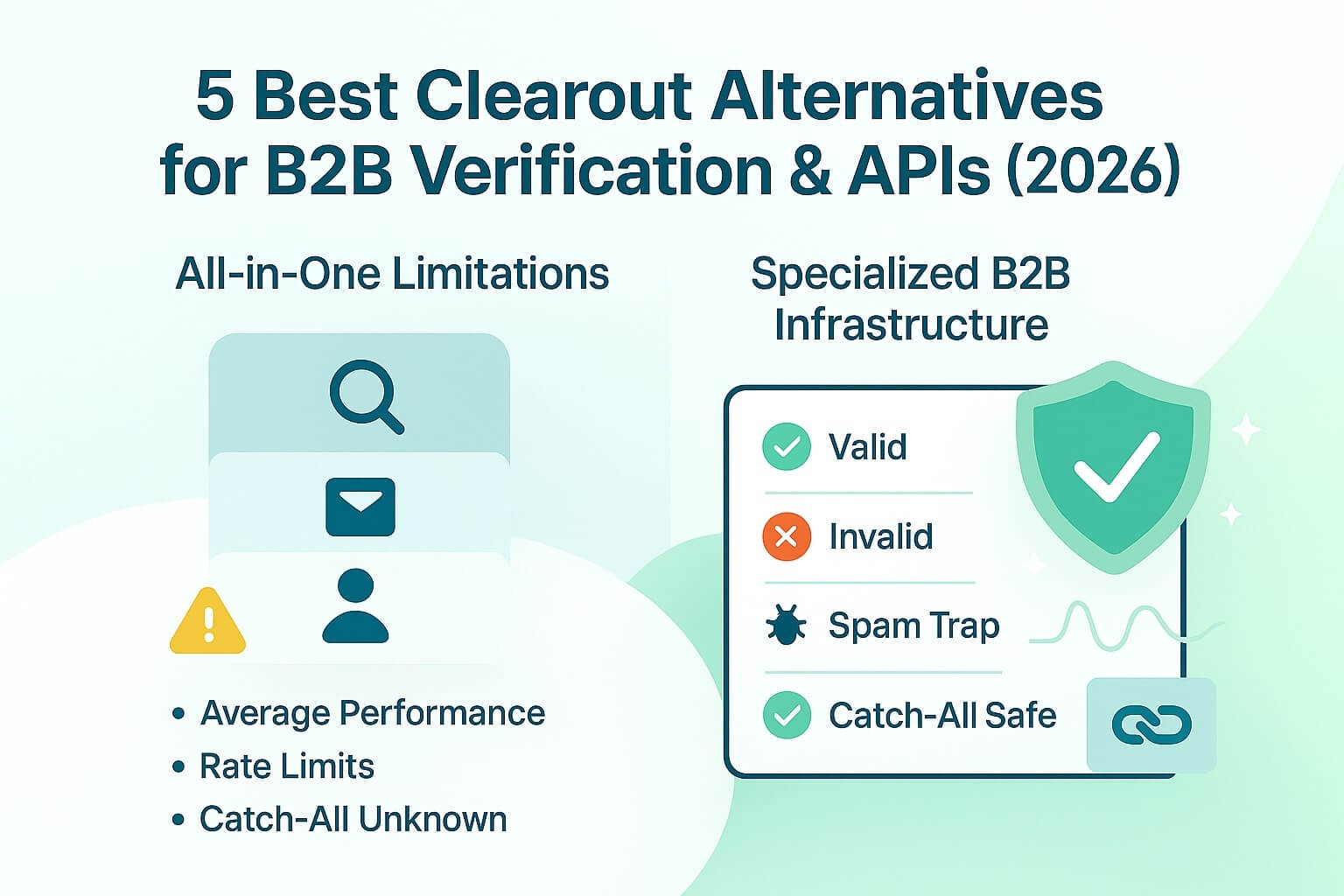
For a freelancer or a very small team just starting out, this bundle is convenient. But for scaling revenue teams, this "all-in-one" convenience comes with a hidden cost: Average Performance.
Because Clearout tries to do everything, it masters nothing. Its API is often rate-limited on standard plans, and — crucially for B2B — it struggles to resolve the complex "catch-all" domains that make up 30-50% of corporate lists.
This guide argues for a different approach: Unbundling your stack.
In high-stakes outreach, you cannot afford to let your reputation take hits due to average verification logic or average finders that serve up spam traps. Instead, the most successful RevOps teams use a dedicated tool to find leads (like Apollo) and a specialized deliverability platform (like Allegrow) to verify data and protect their ability to reach the inbox consistently.
Here is why you should switch, and the best alternatives to consider.
TL;DR: Scaling revenue teams are increasingly replacing Clearout to avoid the conflict of interest inherent in an "all-in-one" platform that validates the same data it sells ("grading its own homework"). While Clearout offers credit-based convenience for freelancers, its generalist architecture creates critical bottlenecks for B2B growth, specifically low API rate limits (55 RPM) and an inability to resolve catch-all domains beyond a vague "unknown" status. Consequently, modern RevOps strategies now prioritize "unbundling" the tech stack — pairing best-in-class finders like Apollo with specialized Clearout alternatives like Allegrow — to ensure unbiased spam trap detection, high-throughput processing, and SEP-native enforcement that actively protects sender reputation.
Clearout Review: The "Jack of All Trades" Trap
On paper, a tool that finds leads and verifies them sounds efficient. However, in practice, this "all-in-one" model creates structural weaknesses that modern teams can't afford to ignore. When a platform tries to do everything, it often lacks the specialized infrastructure required to solve the hardest problems—specifically, verifying the complex firewalls protecting your best prospects. Furthermore, this model creates a conflict of interest that actively decays data quality.
The Conflict of Interest
There is a fundamental misalignment in the "Finder + Verifier" model: the tool is effectively grading its own homework. When you purchase a lead from a prospecting platform, their primary revenue goal is to sell you that contact record. If they immediately flag that same contact as "Invalid", they cannot justify charging a credit for it.
This creates a subtle but dangerous financial incentive to mark questionable emails as "Valid" or "Safe to Send". They tend to be optimistic about data quality because their business model depends on volume. In high-stakes outbound, optimism is a liability. You don't want a cheerleader; you want a rigorous gatekeeper.
To protect your domain reputation, you need an impartial judge. You need a dedicated verification infrastructure whose only job is to ensure safety, completely decoupled from the incentive to sell you the lead in the first place. Relying on a finder to verify its own data is a recipe for slowly creeping bounce rates and decaying replies.
The "Catch-All" Blind Spot
For B2B teams targeting mid-market and enterprise companies, roughly 30% of your list will consist of "catch-all" (accept-all) domains. These servers are configured to accept all incoming mail initially, making it incredibly difficult for standard SMTP checks to determine if a real person or a spam trap exists behind the address. This is the specific technical hurdle where generalist tools stumble.
Independent audits suggest that Clearout’s accuracy on the detection of these complex catch-all domains hovers around 74%. However, it’s important to note that this benchmark applies only to detection, not resolution. This causes them to return an "Unknown" risk status for all these contacts, leaving your team to guess whether they should approach that lead or not.
While this might be acceptable for low-risk marketing newsletters, it leaves a massive gap for sales teams. Generalist verifiers often lack the historical data and proprietary signals required to penetrate these corporate firewalls, forcing them to return a risk-averse "Unknown" status for perfectly good leads.
The business impact of this blind spot is severe. If you are discarding 1 in 4 prospects because your verifier can't definitively solve the catch-all puzzle, you are artificially shrinking your Total Addressable Market (TAM). You are paying to acquire leads, only to throw them away because your verification tool lacks the sophistication to confirm they are safe.
Pricing for "Finder" Features You Don't Need
Finally, consider the efficiency of your tech stack. Clearout’s pricing bundles verification credits with prospecting credits, meaning you are paying a premium for their data sourcing capabilities. However, most modern revenue teams already rely on best-in-class databases like Apollo or ZoomInfo to find their leads.
If you are already paying for a premium data source, using Clearout means you are double-paying for a redundant, "B-grade" finder that you likely won't use. That budget is being wasted on shelfware rather than performance.
It is far more capital-efficient to unbundle your stack. Allocate your budget toward the best possible finder for sourcing, and then invest the savings into an "A-grade" infrastructure tool dedicated solely to deliverability and protection. This ensures you aren't paying for features you don't need, while getting superior performance on the one feature that actually protects your revenue.
The Role of Email Verification APIs (And Why Clearout Struggles)
While many teams start with manual CSV uploads, growing businesses eventually need to automate their data hygiene. Whether you are connecting a real-time signup form, integrating directly with your CRM, or building a custom product feature, you are likely relying on an API.
To choose the right alternative, you first need to define which "mode" of automation your business actually needs to make sure your choice is the best fit for your outbound email cadences.
How APIs Protect Your Funnel
Verification API infrastructure generally serves two distinct functions:
- The "Bouncer" (Real-Time Protection): This sits on your signup forms or lead magnets (often via a widget or API). Its job is to block fake emails (like test@test.com) instantly so they don't pollute your database. In this mode, speed is everything. You cannot afford to make a user wait 5 seconds for a "valid" check; you need sub-second responses.
- The "Auditor" (Backend Hygiene): This sits between your CRM and your Sales Engagement Platform (like Outreach). Its job is to scan leads before your SDRs email them. In this mode, depth is everything. You don't care if it takes 10 milliseconds or 10 minutes; you care that it catches the hidden spam traps that would otherwise burn your domain.
The Clearout API Bottleneck
This is where Clearout’s architecture starts to show its limitations. On standard plans, Clearout’s API is often rate-limited to around 25 to 55 requests per minute (RPM).
For a small business, this is fine. But for a growing B2B team triggering enrichment workflows or a B2C company running paid ads, 55 RPM is a massive bottleneck. That is less than one request per second. If you launch a successful campaign and traffic spikes, your verification tool effectively becomes a bottleneck on your own growth, causing timeouts and lost leads because the infrastructure simply cannot keep up with the volume.
What to Look for in an API Alternative
Because Clearout tries to play the middle ground, it fails the stress test on both ends.
- If you need High Speed (B2C): You need a dedicated high-throughput infrastructure that can handle 500+ RPM without blinking.
- If you need High Accuracy (B2B): You need an asynchronous, infrastructure-grade platform (like Allegrow) that prioritizes deep-scan resolution over instant, shallow answers.
You need a specialist that dominates your specific use case, not a generalist that caps your growth.
Top 3 Clearout Alternatives (Ranked by Use Case)
Since no single tool can be "best" at everything, the right alternative depends on your primary goal: do you need reputation protection, marketing simplicity, or consumer-grade speed?
1. Allegrow (Best for B2B Deliverability & API Speed)
Best For: Revenue GTM Teams (RevOps/SDRs) and High-Volume Data Providers.
Allegrow is designed specifically for the complexity of modern B2B outreach, where the risks are hidden behind corporate SEGs like Mimecast and Proofpoint. Unlike Clearout’s generalist approach, it uses proprietary behavioral signals—not just simple SMTP pings—to resolve "catch-all" addresses with a definitive "Valid" or "Invalid" status. This depth allows it to identify the "silent killers" of domain reputation: hidden spam traps, manual complainers, and inactive inboxes that don't bounce but still destroy your engagement rates.
Beyond just verification, Allegrow integrates natively with sales engagement platforms like Outreach, Salesloft, and HubSpot to automatically verify and block risky emails before every send.
For data providers and engineering teams, the platform offers infrastructure-grade API flexibility. You can choose between Synchronous endpoints for real-time applications and Asynchronous processing for deep-batch enrichment, ensuring you never have to choose between speed and accuracy. Crucially, it also allows you to customize your own mix of SMTP and signal-based verification logic to match your specific risk tolerance.
- Pros:
- Actionable Catch-All Resolution: Turns "Unknowns" into actionable "Valid" or "Invalid" verdicts.
- Pre-Send "Safety Net": Automatically stops sends to bad emails inside the SEP workflow, removing human error.
- Infrastructure-Grade API: High-throughput options (millions of verifications per day) with customizable logic for data providers.
- Cons:
- Not a Finder: You must bring your own list from a source like Apollo or Clay.
- Subscription Model: Built for continuous usage, which may be overkill for a one-time scrub.
2. ZeroBounce (Best for Permission-Based Lists)
Click here to read a full in-depth review of ZeroBounce.
Best For: Permission-based lists & Newsletters.
ZeroBounce is a market leader for standard list hygiene, making it an excellent choice for marketers managing large, opt-in subscriber bases. Its strength lies in its ecosystem of native connectors for marketing tools like Mailchimp, Constant Contact, and HubSpot Marketing Hub, allowing you to keep your newsletter lists clean of hard bounces with minimal manual effort. It also offers valuable "append" services, allowing you to enrich your existing customer data with missing names, locations, or IP information.
However, its architecture is less suited for the high-risk world of cold B2B outreach. While highly accurate for standard consumer emails, it often struggles to resolve the complex Secure Email Gateways (SEGs) used by enterprise companies, frequently returning an "Unknown" status for corporate contacts.
- Pros:
- Marketing Integrations: Deep connectivity with ESPs for automated newsletter hygiene.
- Data Enrichment: Adds valuable demographic data to your existing lists.
- Cons:
- Limited B2B Depth: Higher rate of "Unknown" results on complex corporate domains.
- No Pre-Send Blocking: Lacks the "Safety Net" integration for real-time sales protection.
3. BriteVerify (Best for Simplicity & Speed)
Click here to read a full in-depth review of BriteVerify.
Best For: High-Volume B2C Lists.
Owned by Validity, BriteVerify is the "Fast Button" of the verification world. It is engineered for massive B2C retailers and platforms that need to verify thousands of consumer emails (Gmail, Yahoo, Hotmail) instantly during a signup process. Backed by Validity's enterprise infrastructure, it is known for its API performance, capable of handling 500+ requests per minute without latency, making it the gold standard for high-traffic web forms that need sub-second responses.
The trade-off for this speed is depth. BriteVerify’s "speed-first" architecture often times out when faced with corporate and slow-responding servers. To maintain its speed, it will frequently mark a valid business email as "Risky" or "Unknown" simply because the server didn't respond fast enough. This makes it a poor choice for outbound teams, as it artificially shrinks your Total Addressable Market (TAM) by rejecting valid leads that just needed a deeper, slower check.
- Pros:
- Extreme Speed: API throughput for real-time consumer applications.
- Reliability: Enterprise-grade uptime supported by Validity’s infrastructure.
- Cons:
- Blind Spots: High "Unknown" rate on corporate catch-alls and slow-response domains due to timeout logic.
- False Negatives: May mark valid business emails as risky to prioritize processing speed.
API Performance Comparison
When you peel back the marketing layers, the technical specs of these tools reveal exactly what they were built for.
- Clearout: Offers a standard rate limit of roughly 55 requests per minute (RPM) on basic plans, and raises it according to the amount of credit you choose to buy. This is adequate for small-sized businesses but creates a dangerous bottleneck for high-traffic environments where scale shouldn't be tied to pre-payment.
- BriteVerify: The winner for raw consumer speed. With limits pushing 500+ RPM and low-latency response times, it is a great choice for massive, real-time B2C traffic where every millisecond counts.
- Allegrow: Built for Unlimited Scale. We don't cap your growth with arbitrary rate limits. Our infrastructure is designed to handle millions of requests per day with consistent uptime. Whether you need high-speed synchronous checks or deep-dive asynchronous verification for complex B2B lists, our API scales elastically to meet your volume without compromising on the depth of verification.
Comparison Table: Feature Breakdown
To make the choice simple, here is how the infrastructure stacks up side-by-side:
Conclusion: Don't Trust a Generalist with Your Reputation
Clearout is a capable tool for freelancers or small teams who want a simple, all-in-one bundle to find and verify a few hundred leads. If convenience is your only metric, it gets the job done.
But for revenue teams scaling their outbound volume, "good enough" verification is a liability. Relying on a generalist tool that grades its own homework leaves your domain vulnerable to the sophisticated risks — spam traps, manual complainers, and complex firewalls — that define modern B2B deliverability.
To protect your pipeline, you must unbundle your stack. Use a dedicated finder (like Apollo) to source the best data, and a dedicated infrastructure platform (like Allegrow) to ensure it is safe to send.
Audit Your List for Hidden Risks Today
Don't guess if your current verifier is missing things — prove it.
Start a 14-day free trial of Allegrow and run a comprehensive risk analysis on up to 1,000 of your contacts. You can compare the results directly against your current tool to see exactly how many invalid catch-alls, spam traps, and dead mailboxes are currently slipping through your defences.