Most people searching for TrulyInbox reviews are doing it for one of two reasons. Either they’ve already tried some form of email warm-up and are still struggling with messages landing in spam, or they are comparing different tools before investing in a long-term deliverability solution. In both cases, the expectation is the same: they want to understand whether TrulyInbox can meaningfully improve inbox placement for outbound email and whether other tools offer better performance.
TrulyInbox is a straightforward warm-up and engagement simulation tool built primarily for users who need the basics. While it performs reasonably well for small teams and budget-conscious senders, it is limited by design. When outbound volume increases or the stakes of inbox placement become higher, most teams begin looking for more robust solutions.
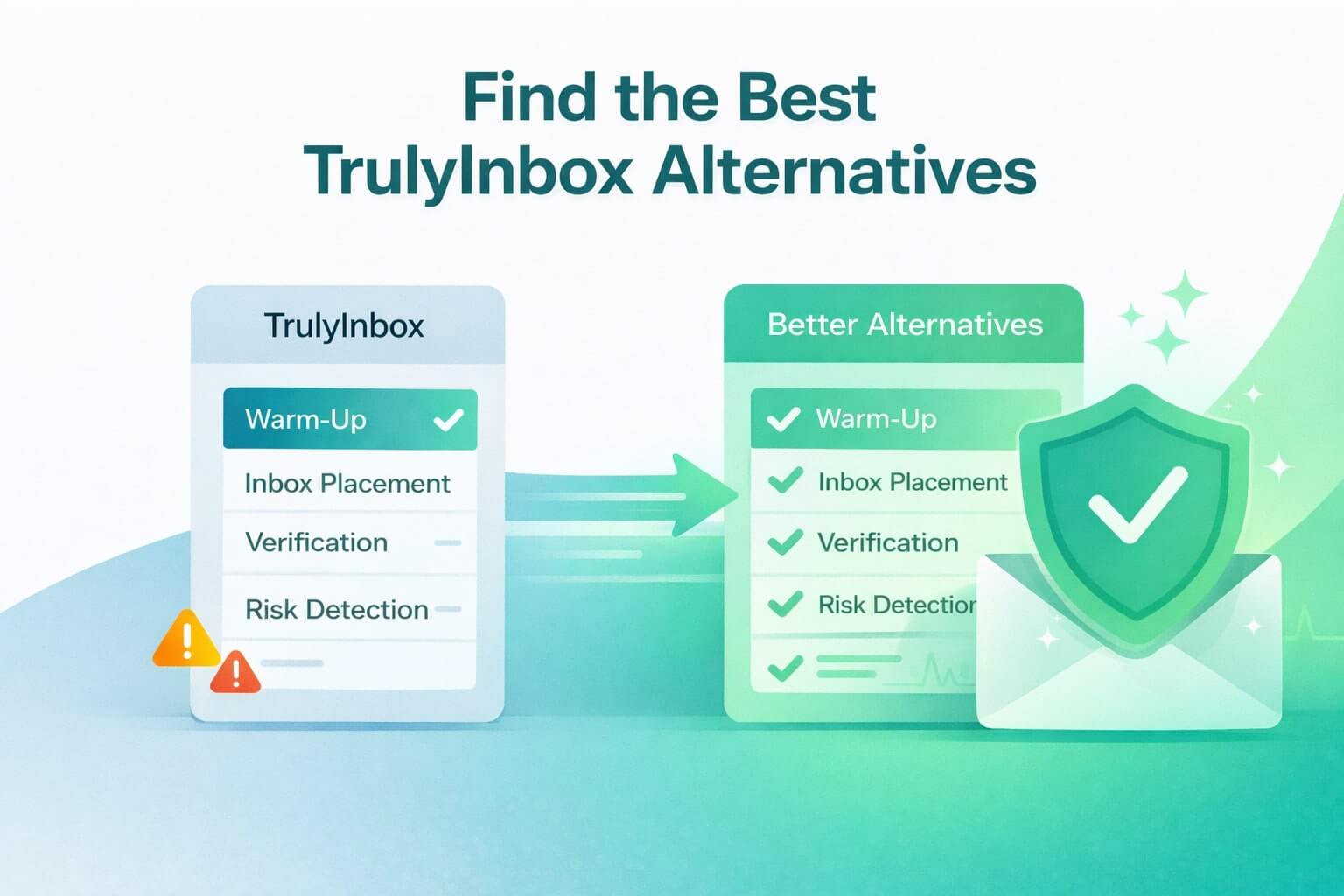
In this article, we’ll break down what TrulyInbox does well and where it falls short for B2B outbound email. We’ll explore common user feedback, clarify the difference between warm-up, inbox placement, and verification, and highlight the essential features any team should consider when evaluating alternatives. Finally, we’ll review top TrulyInbox alternatives like Allegrow, InboxAlly, and NeverBounce, comparing their capabilities, pricing models, and suitability for different outbound strategies, so you can make an informed choice for your team’s deliverability needs.
TL;DR: TrulyInbox offers a basic warm-up and engagement simulation that may help new senders establish early trust with inbox providers. However, reviews consistently highlight that warm-up alone cannot prevent spam issues - especially in B2B outbound, where domain reputation and list quality play a much larger role. Allegrow addresses these challenges by providing visibility into risky addresses, confirming which catch-alls are truly valid or invalid, flagging spam traps and reporters, and continuously monitoring authentication, giving teams actionable insights that directly reduce deliverability risk. InboxAlly is a strong supplement for improving engagement signals, and NeverBounce remains a reliable option for batch scrubs, even though its catch-all results remain “unknown,” limiting its effectiveness for outbound teams.
What is TrulyInbox and Who Is It Best For?
TrulyInbox is an email warm-up and engagement simulation platform. Its core functionality revolves around generating artificial but structured interactions (such as opens, replies, and message movements) within a network of controlled mailboxes. These interactions are designed to show inbox providers that your sending domain consistently produces positive engagement, which should increase trust and improve early deliverability.
Several independent reviews describe TrulyInbox as accessible and easy to operate. SalesHandy’s coverage notes that the tool appeals to users who want a simple warm-up interface without complicated setup steps. Additionally, Mailivery’s review similarly points out that unlimited mailboxes and low entry pricing make it an attractive first step for teams that are just beginning to tackle deliverability challenges.
For these reasons, TrulyInbox tends to be most useful for new senders, small teams experimenting with outbound for the first time, or operators who need a budget-friendly warm-up tool with minimal learning curve. It supports the early stages of domain trust building, helping senders reduce cold start problems that often occur when a domain has no sending history.
However, TrulyInbox does not extend beyond warm-up. It does not authenticate risk in your contact lists, monitor inbox placement trends, or provide protection against harmful sending behavior. As outbound scales, these missing pieces become increasingly important, which is why many teams eventually start searching for a TrulyInbox alternative that addresses not only warm-up but also the structural causes of spam placement.
What Real Users Say About TrulyInbox: Review Themes
Some of the recurring themes across TrulyInbox reviews are clear and align across several independent reviews. On the positive side, users tend to appreciate the simplicity of the platform. It is easy to connect multiple mailboxes, requires minimal configuration, and does not overwhelm users with advanced deliverability settings. The inclusion of unlimited mailboxes at lower price tiers is also mentioned frequently and is one of the tool’s most commented selling points.
On the other hand, several common criticisms appear in these reviews. The Digital Merchant’s alternative guide notes that customer support responsiveness can be inconsistent and that pricing increases as the use case grows. More importantly, reviewers repeatedly highlight that TrulyInbox does not provide any guarantees regarding inbox placement because it does not address the deeper technical factors that influence spam filtering.
Another factor worth acknowledging is that TrulyInbox’s public review footprint is thin compared to more established deliverability platforms. This makes it difficult to evaluate its performance across different industries, mailbox providers, or sending volumes.
Email deliverability depends heavily on factors unique to each sender, such as list quality, past spam complaints, and how mailbox providers filter incoming messages - especially on platforms like Microsoft and Google. Because of this variability, most deliverability experts recommend testing any warm-up tool on your own domain to see real results, rather than assuming it will work the same for everyone.
Warm Up vs Inbox Placement vs Verification: Understanding the Difference
One of the biggest misconceptions in outbound email is the belief that warm-up alone can solve spam placement. Warm-up is valuable, but it influences only one dimension of deliverability. A more complete strategy requires understanding the difference between warm-up, inbox placement tools, and verification.
Warm-up focuses exclusively on increasing early engagement to help mailbox providers view your sending behavior positively. Tools like TrulyInbox or InboxAlly do this by generating artificial replies and opens. This helps create early trust signals but does not protect you from risky contacts or underlying technical issues.
Inbox placement platforms operate at a different level. They measure whether your messages land in spam, inbox, or promotions, track spam rates, surface deliverability shifts across providers, and help prevent systemic issues such as authentication drift (SPF, DKIM, DMARC), engagement decline, or domain reputation erosion.
Verification tools address the third layer: list quality and risk identification. NeverBounce is a commonly used example, but verification varies dramatically among providers. Basic verifiers only check syntax, MX, and SMTP responses. More advanced verification tools, such as Allegrow, use 30+ risk signals to identify spam traps, spam reporters, inactive addresses, and “valid” and “invalid” statuses in catch-all contacts instead of the vague “unknown” response that traditional verifiers return.
Outbound teams cannot rely on warm-up alone. That’s because the largest threats to deliverability (spam traps, manual reporters, inactive mailboxes, and catch-all uncertainty) cannot be influenced by engagement simulation. These risks require a holistic approach, with verification, monitoring, and warm-up needed to consistently win the ibox.
Non-Negotiable Features If You’re Replacing TrulyInbox
When evaluating a TrulyInbox alternative, outbound teams typically need a combination of capabilities that extend far beyond warm up and engagement simulation. The reason is simple: inbox placement for B2B outreach is critically dependent on domain reputation, which gets influenced largely by list safety and deliverability best practices, instead of warm-up alone.
When evaluating a replacement for TrulyInbox, B2B teams should look for tools that address the full spectrum of inbox risk. Key capabilities include:
- Automated warm-up with technical checks: Warm-up should be combined with continuous monitoring of SPF, DKIM, and DMARC to catch authentication issues before they harm your sender reputation.
- Advanced verification, including catch-all analysis: A robust solution goes beyond identifying dead emails. It verifies the true status of catch-all domains, replacing “unknown” results with definitive valid or invalid verdicts. This is critical for outbound teams, as corporate catch-all domains can account for up to 30% of contact lists.
- Detection of hidden threats: Spam traps, recycled addresses, and manual reporters can silently degrade your domain reputation. Most basic warm-up tools, including TrulyInbox, cannot detect these risks.
- Inbox placement monitoring: Understanding where emails land (inbox, spam, or promotions) is essential. Without this insight, teams have no real measure of how sending behavior affects deliverability.
- Pre-send blocking of risky contacts: Preventing messages from being sent to high-risk or invalid addresses is one of the most effective ways to protect domain reputation and maintain deliverability at scale.
In short, any tool that lacks risk visibility, placement insights, or contact-level safety checks cannot fully address the spam and bounce issues B2B outbound teams face.
Best TrulyInbox Alternatives for B2B Outbound
To evaluate the top alternatives, this guide uses criteria based on the non-negotiable features above and focuses specifically on tools suited for B2B outbound environments. This includes considerations such as integration depth, verification accuracy, authentication monitoring, and long-term cost of ownership. Let’s take a closer look at what each alternative has to offer.
Allegrow: The Best TrulyInbox Alternative for B2B Inbox Placement
Allegrow is designed as an all-in-one platform for B2B outbound teams that need deeper visibility into deliverability risk. Unlike basic warm-up or verification tools, Allegrow combines multiple layers of protection, monitoring, and automation to help teams reduce bounce rates, protect domain reputation, and maintain inbox placement even at scale.
Pros:
- Advanced verification engine (Safety Net) analyzing 30+ risk signals, providing valid/invalid verdicts even for catch-all domains.
- Detects hidden risks like spam traps and manual reporters.
- Integrates with sales engagement platforms for pre-send blocking.
- Automated warm-up with hourly SPF, DKIM, and DMARC checks.
- Inbox placement monitoring and spam rate visibility.
- Unlimited verification and scalable API for high-volume outbound.
Cons:
- Subscription-based pricing may be higher than simple verification or warm-up tools.
- More features may require some initial setup for smaller teams.
Best for: SDR teams, RevOps leaders, and companies running high-volume outbound sequences who need full visibility and control over deliverability risk.
InboxAlly: The Best Engagement-Based Warm-Up Add-On
Click here to read a full in-depth review of InboxAlly.
InboxAlly focuses specifically on improving sender engagement by simulating user interactions and training inbox providers to recognize emails as wanted. It does not aim to replace verification or full deliverability suites but is highly effective for enhancing warm-up efforts and restoring engagement signals for domains that have seen low activity or poor response rates.
Pros:
- Generates engagement signals to “train” inbox providers and improve reputation.
- Helps restore positive engagement patterns in low-activity or cold sending domains.
- Lightweight tool focused on warm-up without requiring complex configuration.
Cons:
- Does not perform list verification or risk analysis (spam traps, manual reporters).
- Does not provide pre-send blocking, authentication monitoring, or inbox placement analytics.
Best for: Teams looking to enhance engagement signals and improve warm-up results as a complement to existing verification or deliverability solutions.
NeverBounce: Best for Batch Scrubs and API Hygiene
Click here to read a full in-depth review of NeverBounce.
NeverBounce is a reliable option for ensuring list hygiene, whether through batch scrubs or real-time API checks. Its focus is on validating email addresses quickly and accurately, making it especially useful for marketing campaigns, large imports, and CRM maintenance. While it does not include advanced detection of spam traps or manual reporters, it remains a solid choice for verifying inactive or invalid mailboxes.
Pros:
- Fast and reliable syntax, MX, and SMTP checks.
- Supports batch scrubs and real-time API integration.
- Widely compatible with ESPs and CRMs.
- Detects inactive or invalid mailboxes.
Cons:
- Catch-all domains are labeled “unknown,” requiring judgment calls for outbound sends.
- Credit-based pricing can become expensive for frequent, high-volume verification.
- Does not detect spam traps or manual reporters.
Best for: Marketing teams, newsletter senders, or companies needing periodic bulk list cleaning or real-time API validation, especially when high-frequency outbound risk management is not the primary concern.
Comparison Table: Lemwarm and TrulyInbox Alternatives
Limitations You Should Know
While each tool brings distinct strengths to the table, understanding their limitations is essential for forming realistic expectations.
Allegrow is optimized for B2B outbound, which means it focuses heavily on list safety, domain protection, and integration with sales engagement workflows. Marketing-only teams that do not engage in outbound may not need this level of specificity.
InboxAlly remains one of the strongest warm-up enhancers, but its capabilities are intentionally narrow. It cannot validate lists and identify harmful contacts, and it does not provide placement data or technical monitoring. It performs exceptionally well when paired with a verification and monitoring solution, but it is not intended to solve spam issues on its own.
NeverBounce is reliable for periodic scrubs, but it is not designed for ongoing risk prevention. The absence of spam trap detection and definitive catch-all statuses makes it insufficient for most outbound teams. Its credit model can also become costly if verification is required frequently.
How to Choose the Right TrulyInbox Alternative
Choosing the right TrulyInbox replacement depends heavily on your sending motion. If you run daily outbound and rely on SDRs or sales engagement platforms, Allegrow is the most complete and reliable solution because it offers the most complete solution for protecting domain reputation and your team's ability to consistently land in the inbox folder.
If your email sending is more permission-based, and you only need periodic list hygiene, NeverBounce may be suitable despite its limitations in outbound environments. If your priority is enhancing engagement signals to strengthen inbox placement across existing messages, InboxAlly can improve warm-up performance, particularly when used alongside more robust verification tools.
Your risk tolerance also matters. Outbound is inherently riskier than marketing because the quality of purchased, scraped, or enriched data varies widely. If you cannot afford domain reputation damage, the safer option is pairing advanced verification, monitoring, and warm-up rather than relying on warm-up alone.
Economics also plays an important role in this decision. Subscription models make the most sense for ongoing verification needs, while credit-based systems are best suited for sporadic use. For teams that want to eliminate verification fees entirely, Allegrow’s unlimited verification model offers predictable spend and higher scalability.
Summary and Next Steps
Warm-up tools like TrulyInbox can help new senders build initial engagement, but they do not address the deeper structural issues that drive spam placement in B2B outbound. Factors such as inaccurate email lists, hidden spam traps, catch-all uncertainty, and misaligned domain authentication are the real threats to sustained deliverability and domain reputation.
The first step in improving your outbound results is to understand how much risk your current lists may be exposing you to. Running a verification with a tool like Allegrow provides insight into inactive mailboxes, risky catch-all domains, and hidden threats such as spam traps or manual reporters - risks that warm-up alone cannot identify.
Allegrow’s 14-Day Free Trial allows you to analyze up to 1,000 contacts, classify catch-alls with definitive valid or invalid statuses, surface hidden spam traps and reporters, and run CSV uploads to see where your lists may be vulnerable. This simple verification step gives a clear picture of your deliverability risk, helping you understand whether your spam placement issues are due to risky contacts rather than gaps in warm-up. Starting with this analysis is the most actionable way to protect your domain and improve inbox placement before scaling outbound efforts.