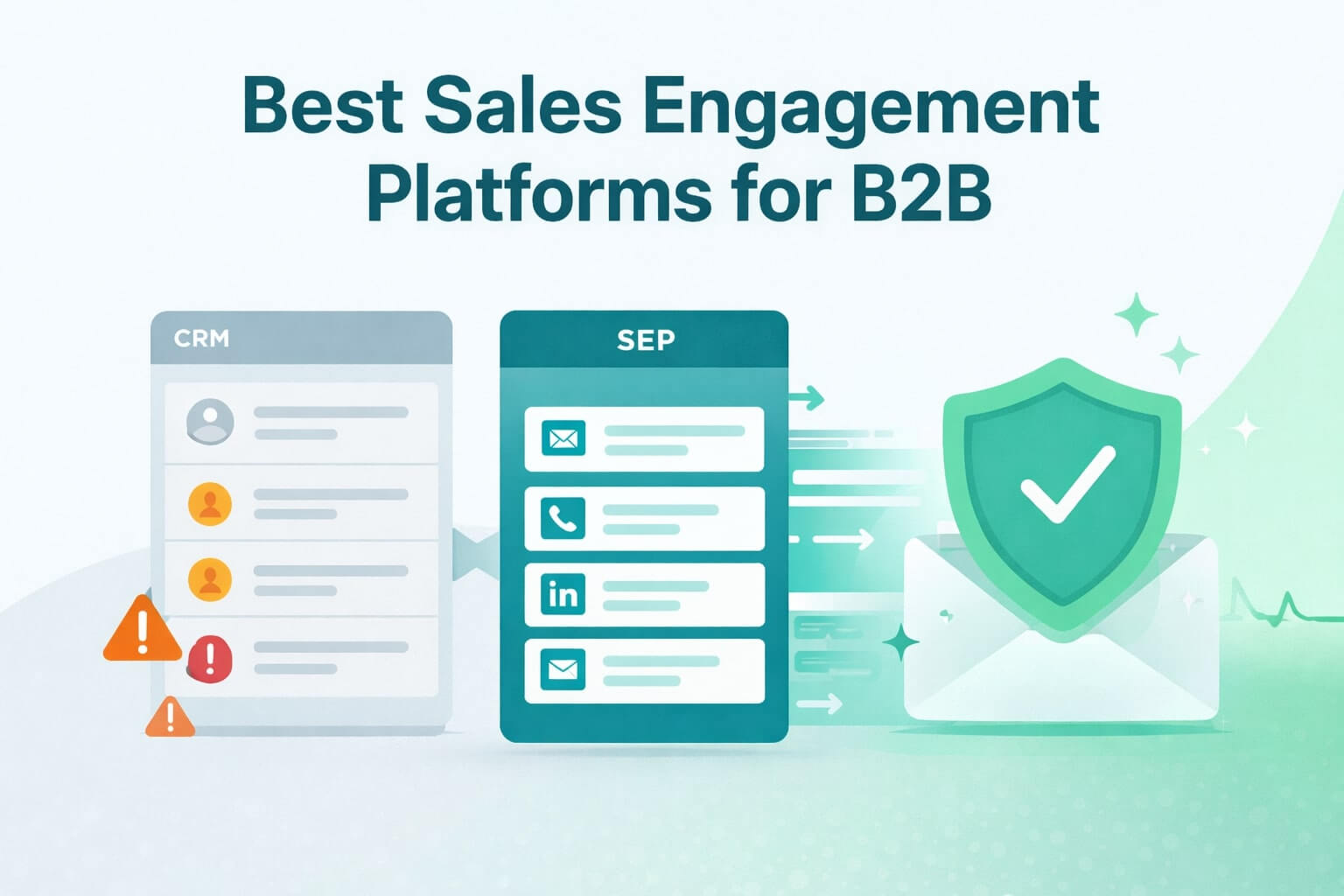
For modern B2B revenue teams, the tech stack has evolved into a sophisticated ecosystem. While your CRM remains the central hub for managing customer relationships and pipeline, high-performing outbound teams require a dedicated layer to execute their strategy at scale.
This is the role of the Sales Engagement Platform (SEP).
An SEP sits on top of your CRM to power the daily workflow of your sales development team. Where a CRM excels at managing active deals and customer data, an SEP is purpose-built for prospecting. It orchestrates the high-volume, multi-channel sequences — email, phone, LinkedIn — that are necessary to break into new accounts and generate qualified meetings.
However, the power to automate outreach comes with a critical risk.
While SEPs make it effortless to scale your volume, they do not inherently solve for email deliverability. In fact, without the right safeguards, the aggressive velocity of a modern SEP can trigger spam filters and damage your domain reputation, causing your emails to miss the inbox entirely.
In this guide, we will break down the top enterprise-class platforms for 2026, explain exactly where the line between your CRM and SEP should be drawn, and reveal the "safety layer" required to protect your sender reputation as you scale.
TL;DR: Sales Engagement Platforms (SEPs) are specialized workspaces designed to orchestrate high-volume prospecting, sitting atop the CRM to automate the multi-channel sequences required for modern SDRs. While market leaders like Outreach and Salesloft excel at workflow efficiency, their aggressive velocity creates a critical risk: triggering spam filters due to sudden volume spikes and unverified data. Consequently, high-performing revenue teams must implement a dedicated "safety layer"—such as Allegrow—to run advanced email verification and resolving catch-all domains directly within the SEP, ensuring that automated scale does not result in domain reputation damage.
What is a sales engagement platform?
A Sales Engagement Platform (SEP) is a specialized workspace designed to execute high-volume, multi-channel prospecting workflows.
Unlike your CRM, which is built to manage qualified opportunities and customer relationships, an SEP is purpose-built to generate them. It often serves as the primary environment for early-stage prospects, allowing sales development teams to execute aggressive outreach strategies without cluttering the corporate CRM with thousands of unqualified contacts.
For revenue leaders, an SEP solves three specific operational challenges that general-purpose CRMs typically do not handle efficiently:
- Orchestration at Scale: It allows a single Sales Development Representative (SDR) to manage hundreds of active prospects simultaneously. By automating the "what to do next" logic, it ensures no lead falls through the cracks due to human error.
- Workflow Enforcement: It enforces a consistent cadence of touchpoints (e.g., 12 touches over 21 days) . This removes rep discretion from the process, ensuring that every target account receives the same rigorous level of effort.
- A/B Testing: It provides granular analytics on messaging performance — such as open rates on subject line A vs. B — allowing you to optimize your outreach strategy based on data rather than intuition.
CRM vs. Sales Engagement Platform: Why can’t I just use Salesforce or HubSpot?
A common friction point in procurement is the apparent overlap in functionality. Since platforms like Salesforce and HubSpot offer native email tools, revenue leaders often ask: Why do we need a separate license for outreach?
The answer lies in the fundamental difference between Marketing Automation and Sales Engagement.
Your CRM’s marketing engine (e.g., HubSpot Marketing Hub or Salesforce Marketing Cloud) is architected for permission-based nurturing, not cold prospecting. Treating your CRM as a cold outreach cannon is not just inefficient — it is a compliance risk that can threaten your entire tech stack.
Why outbound teams still need a dedicated SEP
The most immediate risk is compliance. Most core CRM platforms explicitly prohibit the use of cold or purchased data in their Acceptable Use Policy (AUP).
For example, HubSpot’s AUP strictly forbids the use of "purchased, rented, or borrowed lists" for their marketing email tools, requiring verifiable opt-in consent for every contact. Similarly, Salesforce Marketing Cloud mandates that customers only message subscribers who have "expressly consented", and their policy expressly forbids the use of "rented, traded, or purchased lists".
Attempting to load thousands of cold leads into these systems often triggers immediate compliance flags. This can lead to the suspension of your email sending privileges or your entire instance. Dedicated SEPs, by contrast, are built to handle cold outbound workflows (provided you manage your own domain reputation) without violating platform terms.
Beyond compliance, the workflow architecture of a CRM is often ill-suited for high-velocity prospecting. CRMs are designed to manage records, whereas SEPs are designed to manage tasks.
When an SDR logs into a dedicated SEP, they execute a linear "Task Queue" — making 30 calls and sending 15 manual emails in a focused sprint — rather than navigating between individual contact records. This high-velocity interface removes the friction of CRM navigation, allowing reps to execute multi-channel steps significantly faster than working directly inside a CRM record.
Finally, dedicated SEPs offer a level of multi-channel density that most CRMs cannot match natively. While a CRM might schedule a simple drip of automated emails, enterprise SEPs allow for complex cadences across channels.
What are the common mistakes when choosing a sales engagement tool?
Buying an SEP is like buying a Ferrari; it offers incredible potential for speed, but if you don't know how to drive it, you will crash faster than you would in a minivan. Most implementation failures don't happen because the software itself is bad — they happen because the operational strategy behind it is flawed.
Buying on feature count instead of admin fit
A frequent error revenue leaders make is selecting the platform with the most dazzling feature list — AI voice coaching, sentiment analysis, complex automation triggers — without considering the administrative burden required to maintain it. Enterprise-grade tools are powerful, but they are not "plug-and-play"; they often require a dedicated Sales Operations administrator to manage governance and troubleshoot integration errors. If you purchase a complex platform without the headcount to support it, the system quickly becomes cluttered with broken sequences and outdated content, leading to low adoption and a wasted investment.
The fix is to buy for your current operational maturity, not your aspirational future. If you are a lean team without a dedicated RevOps function, a simpler, more intuitive platform that your sales manager can administer is often more effective than a feature-rich enterprise suite that requires a full-time engineer to run. It is better to have a simpler tool that is used perfectly than a powerful tool that is used poorly.
Turning on "100% Volume" immediately (The Ramp Plan)
The most dangerous psychological trap of an SEP is the ease of execution. Because the tool removes the manual friction of hitting "Send", leaders often assume that because the software can send 1,000 emails a day, they should. This sudden spike in volume is the fastest way to destroy your domain reputation, as modern spam filters (Google and Yahoo) view instant velocity spikes as a clear signal of a spam attack, blocking your domain immediately.
To avoid this, you must implement a strict "Ramp Plan", treating your new SEP like a new employee that needs onboarding. Begin with a conservative volume and slowly increase that number each week over a 4–6 week period. This gradual increase allows mailbox providers to recognize the new traffic pattern as legitimate business growth rather than a coordinated spam raid.
Speeding up bad data (Garbage In, Garbage Out)
An SEP is, fundamentally, an accelerator that amplifies whatever you feed into it. If you feed it high-quality, verified data, it accelerates your pipeline; if you feed it unverified emails or dirty lists, it simply accelerates your bounce rate. Many teams mistakenly believe the SEP will clean their process, but running a high-velocity sequence on a list with a 20% "Unknown" or "Invalid" rate will tank your sender score in days, effectively broadcasting to Google and Microsoft that you are a spammer.
You cannot rely on the SEP to be your data hygiene layer. You must implement a rigorous verification step before contacts enter the sequencing engine. By ensuring that only "Safe-to-Send" contacts are enrolled, you ensure that your accelerator is generating conversations, not just compliance flags.
Top 3 enterprise sales engagement platforms for 2026
While analyst firms list over a dozen significant providers in the sales engagement landscape, the enterprise evaluation shortlist typically starts with two dominant players — Outreach and Salesloft — before expanding to include ecosystem-native challengers like HubSpot.
Choosing between them is rarely about feature counting; it is about choosing an operating philosophy. Do you need rigid governance, adaptive coaching, or platform consolidation?
Outreach: Best for complex enterprise workflows and governance
Outreach is widely positioned as an "AI Revenue Workflow Platform", and its product story leans hard into operational control. For large enterprises where standardized process and compliance are non-negotiable, Outreach offers the most robust architecture for locking down exactly how a deal is run.
Where Outreach stands out is its attempt to systematize the "how we sell" across roles — going beyond SDR sequencing to include Account Executives and leadership.
- Deal-Level Rigor: Their "Deal Overview" explicitly rolls up signals from "Success Plans" (mutual action plans) and opportunity details into a single summarized view, allowing managers to diagnose deal health without digging through CRM notes.
- Kaia Smart Assist: Rather than just transcribing calls, Kaia allows reps to ask natural-language questions about what was discussed in previous meetings (e.g., "What were the objections raised last week?"), providing deep links to relevant moments in the recording.
- Enrichment Governance: For teams managing massive datasets, Outreach provides "cascade enrichment controls", allowing Ops leaders to dictate exactly when and how data is enriched to prevent budget waste.
Best For: Organizations that value compliance, governance, and repeatable process more than flexibility.
Salesloft: Best for rep adoption and signal-driven prioritization
If Outreach is the tool for "Process", Salesloft is the tool for "Rhythm". Their modern center of gravity is Conductor AI, an engine designed to solve the "paralysis by analysis" problem that plagues SDRs.
Instead of presenting a static list of tasks, Salesloft uses Conductor AI to ingest buyer signals from across the tech stack and translate them into a prioritized workflow. This is known as "Rhythm" — a dynamic queue that re-prioritizes a rep’s day in real-time. If a high-value prospect views a contract, Conductor AI bumps that action to the top of the list, ensuring effort is always aligned with intent.
- Signal-to-Action: The platform explicitly evaluates seller activity, buyer engagement, and opportunity data to rank the "next best action", removing the guesswork from the rep’s day.
- Coaching Workflows: Salesloft continues to differentiate on "Coaching Enablement", using AI to flag reviewable moments in conversations and tie them directly to deal outcomes, fostering a culture of continuous improvement rather than just compliance.
Best For: Teams that want high adoption and a strong signal-to-action operating rhythm, without designing every motion as a locked-down playbook.
HubSpot Sales Hub: Best for teams standardizing on a single platform
HubSpot Sales Hub is a legitimate enterprise contender, listed by Forrester as a significant provider in the SEP landscape. However, its strength lies in platform consolidation rather than standalone sequencing power.
The primary argument for HubSpot is friction reduction. If your marketing and sales data live in the same database, you eliminate the "integration tax" of connecting disparate tools. A sales rep can see a marketing email open immediately because they are working in the same system of record.
- The Integration Reality: Be careful with the "instant sync" myth. If you use HubSpot Sales Hub with Salesforce, you are still subject to connector sync rules. HubSpot’s own documentation clarifies that standard syncs run on scheduled intervals (often every 15 minutes), meaning cross-system visibility is not truly real-time.
- Single-Vendor Strategy: It is the strongest fit when your sales motion and reporting are designed around HubSpot as the core system. It unifies the tech stack, reducing sprawl and making RevOps management significantly easier.
Best For: Teams that want to minimize tool sprawl and keep execution centered in one place — provided the outbound compliance strategy (especially regarding cold email) is strictly managed.
The hidden risk: Why can sales engagement platforms destroy deliverability?
The cruel irony of a Sales Engagement Platform is that the features designed to make you efficient are often the same ones that make you look suspicious to email providers.
Fundamentally, an SEP acts as an accelerator. It allows a single representative to contact hundreds of cold prospects at a time. However, to a modern Secure Email Gateway (SEG), this sudden, mechanized spike in outgoing volume looks less like a productivity win and more like a coordinated "Spam Raid" or phishing attack.
This danger is compounded by a critical gap in visibility. SEPs are architected to report on engagement — opens and clicks — not placement. If your emails are landing in the Spam folder, your SEP will simply report "0 Opens", leaving you to thiking your subject line was bad, when in reality the message was never actually seen. Worse, if your emails are scanned by security bots, the platform often reports these as "High Opens" or false positives. Because the SEP cannot see inside the prospect's inbox, you may unknowingly continue accelerating a damaged domain for weeks, burning through your total addressable market (TAM) before you realize your reputation has tanked.
Without a dedicated safety layer, unlocking the speed of an SEP often leads to domain exhaustion. You aren't just missing targets for the current month; you are permanently damaging your domain's ability to reach those accounts in the future, turning your expensive efficiency tool into a liability.
The missing layer: How to protect your SEP with Allegrow
If an SEP is the high-performance engine designed for speed, Allegrow is the navigation system and braking mechanism designed for safety. Just as you wouldn’t drive a Formula 1 car without a roll cage, you shouldn’t run an enterprise SEP without a deliverability layer.
Crucially, this safety layer does not require your reps to change their workflow. Through native integrations with Outreach, Salesloft, and HubSpot, Allegrow acts as a pre-send gatekeeper. Before any email leaves the outbox, our Safety Net analyzes the recipient's risk profile.
If a contact is flagged as invalid or a known spam trap, the system automatically pauses that specific step in the sequence. This prevents your team from accidentally triggering the very signals that cause domain blocks, all without the rep needing to manually check a separate dashboard.
Going beyond, Allegrow also solves the "Catch-All" data gap that plagues most B2B teams. Standard verification tools often return a generic "Unknown" status for up to 30% of enterprise emails, forcing revenue leaders to gamble on whether to send or suppress.
Allegrow resolves these risky emails with definitive "Valid" or "Invalid" statuses directly inside your sequencing workflow. This allows you to unlock valid decision-makers that your competitors are suppressing while avoiding the bounces that damage your reputation.
What are the best practices for implementing a sales engagement platform?
Implementing an SEP is not just a software installation; it is a change management process for your entire domain infrastructure. To ensure your new "Ferrari" doesn't crash on the first lap, follow these three non-negotiable protocols.
Traffic Pacing: The 4-Week Ramp
The most common failure mode is turning the dial to "100" on day one. If your domain has historically sent 500 emails a week and suddenly sends 5,000 via your new SEP, algorithms at Google and Microsoft will flag this anomaly as a compromise event.
You must implement a strict Ramp-Up Schedule. Start your team at 20% of their target volume in Week 1. Increase by 20% each subsequent week, reaching full capacity by Week 5. This gradual slope teaches the mailbox providers to expect and trust your new volume, establishing a baseline of legitimate activity rather than a spam spike.
For more in-depth information on warming up an email domain check our full guide on this subject.
List Hygiene: Verify Before Every Send
Your SEP is a high-performance engine, but it runs on data. If you pour contaminated fuel—invalid emails, spam traps, or decayed contacts—into the tank, you will destroy the engine. B2B data decays at roughly 2.1% per month, meaning a list you bought last quarter is already a liability.
Do not rely on the SEP to clean your data; most platforms will happily attempt to send to invalid addresses until you are blocked. You must implement a strict "Verification Gate". Before any contact enters a sequence, it must pass a definitive check. This is crucial for "Catch-All" domains, which legacy verifiers often mark as "Unknown". Sending to these without validation is a gamble that frequently results in the hard bounces that tank your sender score.
Domain Strategy: Isolate Your Reputation
Never run high-velocity cold outbound from your primary corporate domain (e.g., company.com). If your SDR team burns the reputation of your main domain, you risk blocking mission-critical emails from your CEO, Finance, and Customer Success teams.
Instead, procure and warm up dedicated sending domains for your SEP (e.g., getcompany.com or trycompany.com). This effectively "quarantines" your prospecting risk. If an aggressive campaign damages the reputation of a secondary domain, your core business operations remain unaffected while you remediate the issue.
This is strategy is more detailed in our email throttling guide.
Monitor Placement, Not Just Opens
Most revenue teams optimize for the wrong metric. SEPs report "Open Rates", but in an era of bot clicks and pixel blocking, this metric is increasingly unreliable.
Shift your KPI to Inbox Placement Rate. This metric tells you exactly what percentage of your mail is landing in the primary folder versus the junk folder. By monitoring this daily, you can spot deliverability decay weeks before it impacts your pipeline, allowing you to throttle volume or clean data before you hit a hard block.
Verify your next 1,000 prospects with advanced analysis
Your SEP will accelerate whatever data you feed it. Don't let it accelerate bounces.
Legacy verifiers leave up to 30% of enterprise emails as "Unknown" or "Catch-All", forcing you to gamble with your reputation.
Stop guessing and start validating.
Start a 14-Day Free Trial with Allegrow and upload up to 1,000 contacts for verificaiton. We will run our advanced traffic analysis to give you definitive "Valid" or "Invalid" sattus on every single contact — unlocking the decision-makers other tools miss while blocking the hidden threats that cause domain degradation.