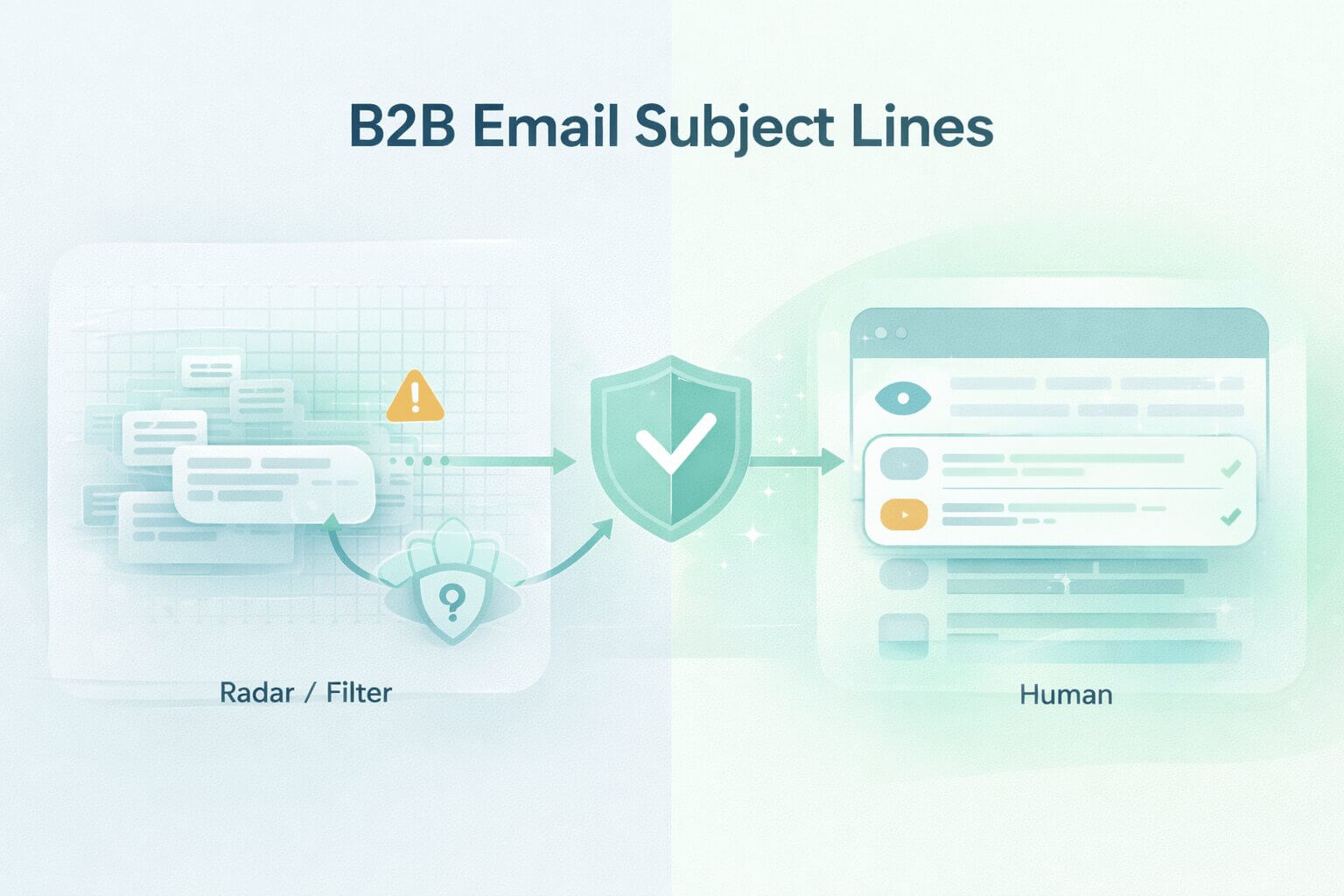
You spend hours perfecting the email body, but the subject line is the gatekeeper. A subject line has two jobs: it must avoid looking risky to mailbox providers and entice the human to click. Getting this balance right is the difference between cold email open rates skyrocketing or sinking. In B2B email, the subject line heavily influences whether your carefully crafted message ever gets a chance to be read.
First, it must pass the machine. Mailbox providers like Google and Microsoft evaluate your subject line as one of many signals when deciding whether your message looks legitimate or spammy. At the same time, it must hook the human. Your prospect scans a crowded inbox and decides in seconds whether your email is relevant or boring. Fail either test, and your open rate collapses.
This guide is built to help you win both. We will break down the psychology behind why people open emails and the technical reality of how modern spam filters interpret subject lines. By the end, you will understand how to write B2B email subject lines that spark curiosity, communicate value, and stay deliverability-safe, so your emails land in the inbox and get opened for the right reasons.
The Psychology of Open Rates: What Makes a Prospect Click?
People are wired to respond to curiosity, utility, trust, and personal relevance. Understanding these triggers is crucial for crafting subject lines that earn opens without creating spam risk signals. In practice, your subject line needs to do two things: get delivered and earn attention once it’s seen. So, let’s take a closer look at each trigger that makes people open emails and how to use them to write the perfect subject line.
1. Curiosity: The Information Gap
Curiosity works because humans are uncomfortable with incomplete information. When a subject line hints at something valuable but does not reveal everything, it creates an “information gap” that the reader wants to close. A subject line like “The surprising reason most CRMs fail” works because it promises insight without exaggeration. It suggests that the email contains knowledge the reader does not yet have, which feels intellectually rewarding rather than salesy.
However, curiosity must be grounded in credibility. Overly vague or sensational phrasing erodes trust and increases the likelihood of spam classification. Professional curiosity performs best when it signals insight, not manipulation. Research from Lemlist shows that curiosity-based subject lines consistently outperform generic outreach in cold email campaigns when executed with restraint.
2. Utility / Value-First
B2B buyers are outcome-driven and time-poor. They open emails that clearly signal a benefit, improvement, or solution. Subject lines such as “Reducing CAC by 20%” or “30 more leads for [Company]” work because they immediately answer the unspoken question: “What’s in it for me?”
Utility-driven subject lines reduce cognitive effort. The prospect does not need to decode the message or guess the relevance. This clarity is especially effective in cold outreach, where trust has not yet been established. According to Belkins, subject lines that reference concrete outcomes significantly outperform abstract messaging in B2B cold email open rates.
3. The Internal Mimic: Trust Through Familiarity
People prioritize emails that look like they came from someone they already work with. Short, lowercase, unpolished subject lines mimic internal communication and reduce the instinctive resistance people have toward marketing emails. Examples like “quick question” feel familiar and low-pressure.
This strategy works because it leverages pattern recognition. The brain classifies the email as potentially important before fully processing it. From a deliverability standpoint, these subject lines can also be safer because they avoid promotional language, excessive punctuation, and formatting patterns associated with bulk campaigns.
4. Personalization: The Ego Bait
Humans are wired to notice their own name, company, and achievements. Personalization signals effort and relevance, which increases the likelihood of an open. Subject lines like “Congrats on the Series B, [Name]” or “Question about [Company]’s growth plans” demonstrate that the email was written for one person, not a list.
Personalization also has a technical benefit. Dynamic elements break uniformity, which helps avoid spam detection systems that penalize identical subject lines sent at scale.
The Technology of Deliverability: How Spam Filters Read Subject Lines
Even the most psychologically optimized subject line fails if it triggers spam filters and never reaches the inbox. Modern spam filters don’t just scan for “bad words”; they evaluate subject lines as part of a broader risk model that includes sender reputation, formatting patterns, and behavioral consistency.
Internet service providers like Google and Outlook are essentially asking whether your subject line looks like something a real person would send or something a system is blasting at scale. Repetitive templates, exaggerated urgency, and uniform formatting increase risk, while natural variation, context, and restraint signal legitimacy. Understanding this machine logic is essential because deliverability is not separate from open rates — it is the prerequisite that makes them possible.
Understanding Fuzzy Hashing: The Anti-Template Mechanism
Some spam filters (for example, Rspamd) use fuzzy matching to detect “template-like” bulk behavior. Rather than relying only on banned words, these systems can generate similarity fingerprints (often based on shingles / content similarity) and compare them to known unwanted patterns.
When the same subject line is sent thousands of times with no variation, that fingerprint becomes easy to recognize. If your subject line is 100% identical across 5,000 emails, it strongly resembles a bulk blast and is likely to match a known spam hash. This is why popular templates degrade over time, even if they once performed well.
The fix is not to avoid templates entirely, but to break the similarity pattern. Introducing dynamic variables such as {{FirstName}}, {{Company}}, or contextual references ensures that each subject line is slightly different. These small variations can reduce bulk-like signals and help avoid classification driven by repetition rather than intent.
Semantic Analysis: How AI Filters Read Intent
Modern spam filters no longer rely on static lists of banned words. Instead, providers like Google use machine learning models to analyze the intent behind a subject line. These systems evaluate context, formatting, sender reputation, and historical behavior to estimate the probability that an email is spam.
This is why individual words are rarely the whole problem. The word “free” on its own isn’t automatically disqualifying. But when it appears alongside all caps, excessive punctuation, and a brand-new sending identity, the combined pattern can signal higher risk. Filters are trained to recognize these compound signals rather than penalize vocabulary in isolation.
Deliverability is ultimately about pattern recognition, not vocabulary censorship. Aggressive formatting, exaggerated urgency, and repetitive structures tend to be stronger negative signals than most so-called spam trigger words. Salesforce confirms that consistency, relevance, and sender reputation matter far more than avoiding specific terms.
The Tension: Where Conversion Meets Deliverability
This is where most B2B email strategies break down, because the tactics that drive opens can conflict with the tactics that protect deliverability. High-conversion subject lines built on manufactured urgency, such as “URGENT: LAST CHANCE,” can create short-term engagement, but they can also increase spam risk signals (especially when paired with repetitive sending patterns, weak sender reputation, or aggressive formatting). Over time, those patterns can contribute to more filtering and weaker placement.
On the other hand, overly cautious subject lines like “Checking in” are usually low-risk from a filtering standpoint, but they can be so nonspecific that they earn fewer opens and replies — especially in crowded B2B inboxes.
The solution is not choosing one extreme over the other, but prioritizing relevance over hype. Subject lines grounded in real business context, like “Q4 budget planning” or “Question about your Q3 goals,” can engage prospects while staying closer to what inbox providers expect from legitimate, person-to-person communication. Balanced tactics support sustainable long-term engagement without sacrificing deliverability.
15 B2B Email Subject Line Templates (Categorized by Strategy)
Templates can be a powerful starting point for B2B email subject lines, but their success depends on more than just copying a catchy phrase. Each template works by triggering a specific psychological response (curiosity, relevance, trust, or urgency) while staying aligned with deliverability best practices.
In the sections that follow, we’ll break these templates into three categories: cold outreach openers, follow-up nudges, and break-up or pattern-interrupt subject lines. For each, we’ll explain why the template engages prospects and how to structure it to reduce common spam risk signals, ensuring your emails are both compelling to humans and more likely to be trusted by the systems that control inbox placement.
Category 1: The Cold Outreach Opener
Cold outreach is all about capturing attention quickly and showing immediate relevance. These subject lines should be concise, value-driven, and non-promotional, signaling that your email is worth the prospect’s time.
- “Idea for [Pain Point]” works because it is short, value-driven, and non-promotional. It frames your email as a potential solution rather than a sales pitch.
- “Question re: [Their Recent Post]” works because personalization breaks fuzzy hashing and signals relevance, showing the prospect that the email was crafted specifically for them.
- “[Company] + [Your Company] partnership?” works because it clearly communicates intent and frames the email as a business conversation, increasing trust and transparency.
- “Quick thought on [Industry Trend]” sparks curiosity while showing you are informed and relevant. Short, topical phrasing helps avoid overly promotional patterns.
- “Helping [Company] reduce [Metric]” provides clear value upfront. The subject line is measurable and concrete, which can increase engagement while staying professional and restrained.
- “Are you exploring [Solution]?” works as a question that encourages a response, signaling relevance without hype or aggressive urgency.
Category 2: The Follow-Up Nudge
Follow-up emails rely on subtlety and familiarity. The goal is to prompt a response without creating pressure or introducing obvious bulk-pattern signals. These lines mimic internal communication, making them feel natural to the recipient.
- “Thoughts?” mimics internal communication and reduces resistance, prompting a reply without feeling like a marketing message.
- “Any feedback on [Project]?” assumes an existing thread and signals continuity, which can increase response rates while keeping the email professional.
- “Following up on my last note” is straightforward and familiar, maintaining a conversational tone that avoids hype-heavy patterns.
- “Quick follow-up on [Topic]” combines relevance and brevity, signaling continuity while staying inbox-safe.
- “Touching base regarding [Initiative]” frames the email as a natural check-in rather than a marketing push, reducing resistance while maintaining context.
Category 3: The Break-Up Pattern Interrupt
Break-up emails or pattern-interrupt subject lines are designed to re-engage prospects who have gone quiet. They often rely on triggers like loss aversion, humor, or curiosity, while still staying professional.
- “Permission to close file?” triggers loss aversion and invites a response by suggesting a potential missed opportunity.
- “Should I stay or should I go?” uses light humor and unexpected phrasing to disrupt inbox patterns, making it stand out while remaining human and professional.
- “Last chance to review [Proposal/Report]?” creates urgency tied to a specific action, avoiding artificial hype that can increase spam risk.
- “Still interested in [Solution]?” prompts a clear yes/no response and reminds the prospect of prior context without exaggeration.
- “One final note on [Topic]” signals closure while providing one last opportunity to engage, leveraging scarcity subtly and safely.
Mobile-First Optimization
In today’s B2B landscape, a large share of inbox engagement happens on mobile, which has significant implications for subject line strategy. Mobile email clients often truncate subject lines in the preview, meaning that any value hidden later in the line may never be seen.
To optimize for mobile, front-load the most important information. For example, a subject line like “Just wanted to check in to see if you…” buries the value and risks being ignored, whereas “Salesforce implementation question…” immediately communicates relevance and purpose. Short, precise, and impactful subject lines not only perform better in mobile previews but also align with human attention patterns, making it easier for recipients to recognize the email’s value at a glance.
By designing subject lines with mobile visibility in mind, you increase the likelihood that your carefully crafted copy is actually seen and considered, rather than lost in truncated text. This approach ensures that your emails engage recipients across devices without compromising deliverability or clarity.
How to Test Subject Lines: A/B Testing Protocol
Even the best-crafted subject line is not guaranteed to perform without testing. What works for one audience, industry, or segment may fall flat for another, and even small changes in wording, personalization, or length can significantly affect open and reply rates.
A structured testing protocol allows you to validate assumptions, identify high-performing variations, and optimize for both human engagement and deliverability. In B2B outreach, this means focusing on metrics that reflect meaningful interaction rather than superficial clicks, and using tools that help safeguard your sender reputation while testing at scale.
Metrics That Matter
Open rate has become increasingly unreliable, largely due to technologies like Apple Mail Privacy Protection, which can automatically fire tracking pixels even if the recipient does not actually open the email.
For B2B campaigns, the most reliable signal is often reply rate, as it reflects genuine engagement and interest from the recipient. Additionally, monitoring spam complaint rate is critical; keeping it as low as possible—many teams aim to stay under ~0.1% and avoid approaching ~0.3%—helps protect domain reputation and reduces the risk of deliverability issues.
The Testing Process
Effective A/B testing goes beyond swapping a single word or punctuation mark. In B2B outreach, the goal is to compare entire concepts rather than micro-variations. For example, you might test short versus long subject lines, curiosity-driven versus utility-focused language, or personalized versus generic phrasing. Each variation should represent a distinct approach to engaging your audience, rather than just a cosmetic tweak.
Start by defining your hypothesis for each test. Ask yourself: Are you trying to increase replies, improve relevance perception, or boost engagement on mobile devices? Clearly identifying the goal allows you to interpret results meaningfully. Next, segment your audience to ensure that each variation is sent to a representative sample of recipients. Randomized segments reduce bias and help you isolate the impact of the subject line itself.
During testing, track multiple metrics simultaneously. The open rate can provide early signals, but the reply rate is often the most reliable indicator of genuine engagement in B2B campaigns. Monitor secondary metrics such as click-throughs, conversions, or downstream actions to understand the full impact of your subject line. Keep tests running long enough to capture statistically meaningful results, accounting for time zone differences and varying email behaviors across recipients.
Finally, iterate systematically. Once you identify a winning concept, refine it by adjusting personalization, length, or phrasing to see if engagement improves further. Over time, this approach builds a library of subject line concepts that are proven to work for your audience, while maintaining deliverability and minimizing risk from repetitive patterns.
Conclusion & Takeaways
A strong B2B email subject line succeeds when it hooks the human without triggering the machine. Psychology drives opens, but infrastructure determines whether those opens are even possible. Template fatigue is real. If thousands of senders copy the same subject line, it becomes a liability rather than an asset.
Instead, focus on relevance over hype, real urgency instead of manufactured pressure, and professional curiosity rather than clickbait. Testing subject lines systematically, measuring reply rates, and iterating on concepts rather than individual words will build a library of high-performing, sustainable approaches.
Finally, balance is key. High-conversion tactics only work if they remain inbox-safe, and safety alone is meaningless if the line fails to engage the recipient. When you combine psychology with deliverability, you create subject lines that consistently earn opens, replies, and meaningful engagement.
For a practical first step, you can start your 14 Day Free Trial to test and verify your subject lines against real-world B2B contacts and ensure they reach the inbox safely.
FAQs
How long should a B2B subject line be?
Shorter subject lines generally perform better, especially on mobile. Aim for one to four words that clearly convey the purpose or value of your email. Concise lines respect the recipient’s time and make your message immediately scannable, increasing the likelihood of an open.
Should I use emojis in B2B emails?
Emojis can increase visibility and add a human touch, but they should be used sparingly in B2B outreach. Overuse can make your emails feel marketing-heavy or unprofessional and may trigger spam filters. Use them strategically to highlight a key point or add subtle personality without overwhelming the subject line.
Does capitalization matter?
Capitalization affects how your email is perceived. Sentence case or lowercase feels more personal and conversational, while title case can make your message appear like a newsletter or mass marketing email. Choosing the right style helps set the tone and subtly influences trust and engagement.
What is the best time to send B2B emails?
There is no universal perfect sending time. Open rates depend more on relevance and context than on clock time. Test different schedules with your audience segments and monitor engagement patterns to determine when your specific recipients are most likely to act.
How many follow-up emails should I send?
Multiple follow-ups are often necessary in B2B outreach, but they must add value and avoid pressuring the recipient. Sending Multiple follow-ups emails are often necessary in B2B outreach, but they must add value and avoid pressuring the recipient. Track responses and engagement carefully, and adjust the frequency based on interaction. Each follow-up should feel purposeful rather than repetitive to maintain trust and preserve deliverability.