When building a registration form, writing a data-cleaning script, or importing a massive contact list, developers need a reliable way to validate email addresses in Python. Relying on unverified data inevitably pollutes your database and ultimately torpedoes your downstream deliverability metrics. To protect your application, you must implement a validation strategy that actively filters out invalid inputs before they ever reach your core systems.
However, Python email validation is rarely a single, binary check. The process actually ranges from simple, lightweight format checks using regular expressions to much deeper, network-level verification methods that query external servers.
In this guide, we will explore the most effective Python validation methods available for your stack. We will break down exactly what each method catches, what critical edge cases they miss, and how to choose the perfect setup for your specific workflow. Whether you are simply filtering obvious typos or trying to secure high-confidence B2B contact lists, you will learn how to build a validation sequence that scales reliably in production.
TL;DR: When building a Python data pipeline, relying on custom regular expressions (regex) to validate email addresses is a fragile strategy that inevitably breaks when processing complex corporate subdomains or internationalized strings. To build a maintainable first line of defense, developers should upgrade to the dedicated email-validator library, which enforces strict RFC formatting rules and executes basic DNS checks to filter obvious typos and dead domains. However, while local Python scripts excel at structural validation, they are entirely blind to the operational reality of the inbox. If you write a custom Python script to execute direct SMTP pings against B2B lists, modern Secure Email Gateways (SEGs) will aggressively block your IP or return false-positive "catch-all" responses. To prevent these dead inboxes from destroying your sender reputation via hard bounces, revenue teams must layer basic Python syntax checks with an asynchronous API like Allegrow, offloading the complex server negotiations required to definitively prove a B2B mailbox is active.
What is python email validation?
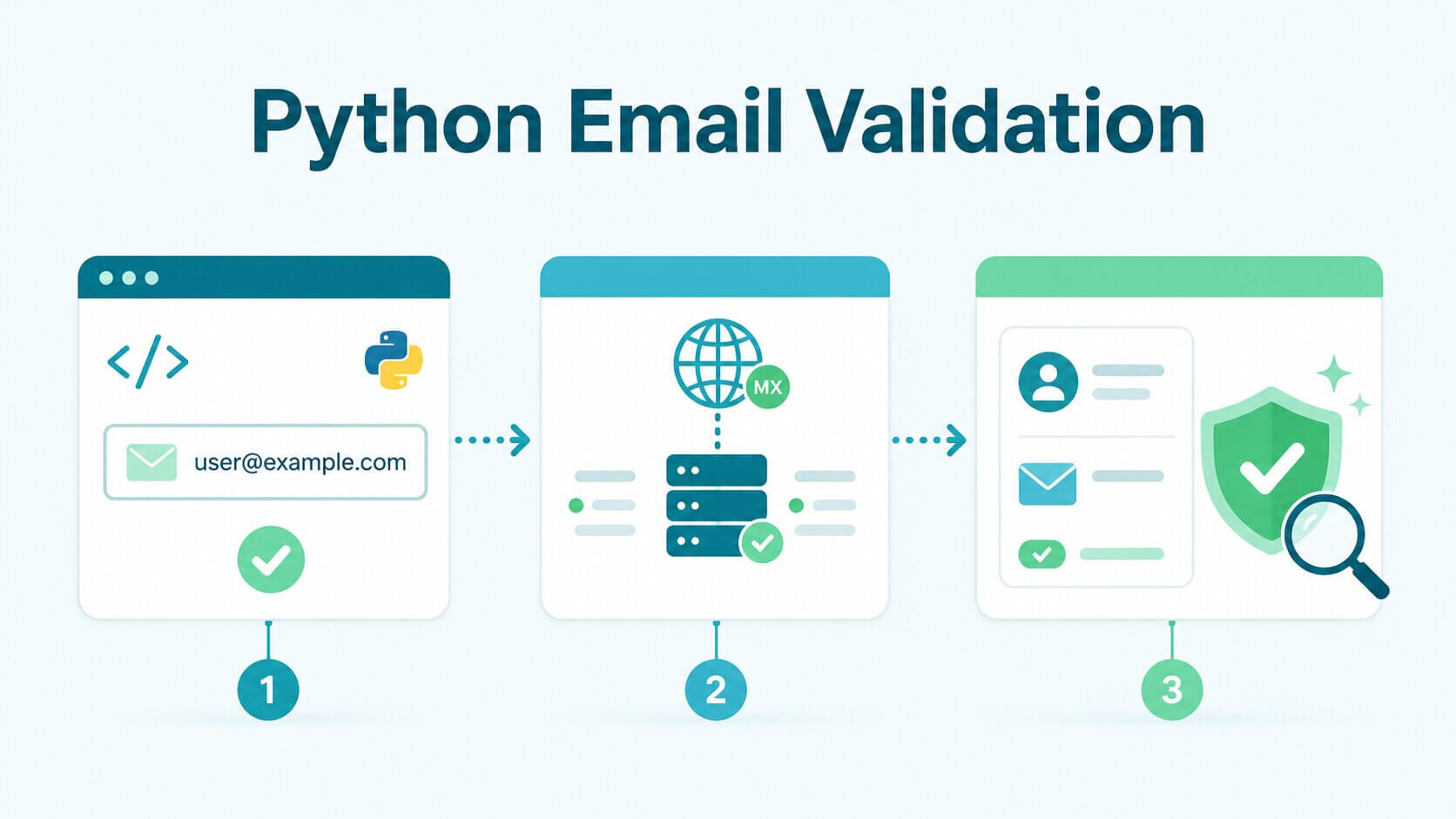
Python email validation is the programmatic process of verifying that a user-provided string is actually formatted as a real, functional contact address. Rather than relying on a single magic function to do this, developers must treat validation as a multi-layered defense system built directly into their application pipeline.
This defensive strategy typically begins with lightweight syntax filters to catch obvious typos and progressively moves toward deep server-level verification. By structuring your checks in these distinct layers, you prevent malformed junk from wasting your compute resources while reserving complex network queries for syntactically perfect addresses.
Ultimately, choosing the right technical method depends entirely on your specific operational goals and the scale of your data. Whether you are simply filtering bad input on a fast web form, validating domains across a massive CSV import, or seeking high-confidence deliverability before sending a B2B campaign, your Python implementation will look drastically different.
What is the simplest way to validate emails in python?
The absolute lightest and fastest way to validate an email address in Python is using standard regular expressions (regex) via the built-in re module. This basic format validation acts as a high-speed filter to instantly catch malformed inputs, missing "@" symbols, or illegal characters before they trigger errors deeper in your stack.
However, while regex is incredibly helpful for maintaining basic data hygiene, it is strictly a structural check. Passing a regex test only proves the string physically looks like an email; it absolutely does not prove that the underlying inbox actually exists or can receive messages.
How should you use regex for python email validation?
When implementing regex in your Python scripts, your pattern should strictly focus on catching obvious formatting issues, enforcing valid character sets, and ensuring the domain contains a proper top-level extension. You must use full-string matching methods like re.fullmatch() rather than basic searches, guaranteeing the entire input string conforms to the rule rather than just a valid substring hidden within garbage text.
The key to using regex effectively is knowing exactly where its responsibility ends. You should never attempt to write a massive, overly complex pattern that tries to perfectly map to every obscure edge case of the official email specification, as this simply creates brittle, unmaintainable code. Instead, use a pragmatic, lightweight regex to block obvious junk, and rely on stronger libraries or external checks to handle the deep validation.
Should you use the email validator library in python?
Relying entirely on custom regular expressions for production applications is a notoriously fragile strategy. As your user base scales to include international domains or deeply nested corporate subdomains, a hand-written regex will inevitably start rejecting perfectly valid formatting. Instead of maintaining an unreadable, thousand-line wall of code, modern development teams upgrade to the dedicated email-validator Python library.
This standard package fundamentally improves how your application handles syntax by strictly enforcing official specifications right out of the box. Because the official IETF standard (RFC 5322) allows highly complex localized formats—including quoted strings and nested comments—attempting to cover every edge case with a hand-written regex is practically impossible and will inevitably reject valid users. It automatically manages tedious input normalization tasks, provides robust Unicode support for global audiences, and executes domain-aware formatting checks that regex simply cannot parse cleanly.
By treating email validation as a standardized utility rather than a custom science project, your engineering team saves countless hours debugging false rejections. It guarantees absolute confidence in the structural integrity of the input without the ongoing maintenance nightmare of custom patterns.
When is the email validator library a better choice than regex?
You should implement the email-validator library whenever your core application logic requires predictable error handling at the boundary layer. Instead of silently failing or simply returning a boolean false, the library throws specific, structured exceptions—like EmailUndeliverableError or EmailSyntaxError—that your backend controllers can easily catch. This predictable behavior allows you to map these granular exceptions directly to clean, user-facing error messages. Ultimately, this makes the library vastly superior to regex for critical registration flows, where confusing UI feedback actively kills conversion rates.
However, it is crucial to remember that this tool is strictly a stronger local validation layer, not a deliverability silver bullet. While it provides basic DNS lookups to verify the domain name actually exists, it still does not confirm whether the specific mailbox is active and ready to receive mail. To achieve that final level of certainty and guarantee your emails will not bounce, you must look beyond local Python libraries and add dedicated network-level checks to your data pipeline.
What should you add on top of python email validation for better accuracy?
To truly guarantee that an email address is usable, your Python scripts must step outside of local string manipulation and interact with the actual domain servers. By adding network-level checks on top of your standard syntax filters, you effectively shift your validation strategy from predicting formatting to verifying real-world routing. These supporting methods deepen your confidence in the data, ensuring you only pass high-quality contacts down your pipeline without needing to build a full-scale deliverability engine from scratch.
How do mx checks improve python email validation?
The most immediate network upgrade you can make is querying the domain name system (DNS) for Mail Exchanger (MX) records. Integrating a package like dnspython allows your script to quickly ask the receiving server if it is officially configured to accept incoming email traffic. While finding an active MX record drastically improves your domain-level confidence by filtering out dead websites, it still cannot prove that the specific user's mailbox actually exists. It simply confirms that the corporate building is open for business, not that your specific recipient is actually sitting at their desk.
How do smtp checks improve python email validation?
For the strongest possible validation signal without actually sending a message, developers often attempt to initiate a direct Simple Mail Transfer Protocol (SMTP) connection. By pinging the receiving server and carefully observing the handshake response codes, your Python script can technically verify if a specific inbox is active and ready to receive mail.
However, managing these direct connections locally is incredibly difficult in a modern production environment. Strict anti-spam firewalls, aggressive rate limits, and unpredictable server behaviors will frequently block your application's IP address if you ping them too aggressively. Therefore, while SMTP checks provide the deepest level of validation, the operational tradeoff is a massive spike in maintenance overhead and frustrating false negatives when enterprise servers inevitably refuse to cooperate.
Instead of fighting a constant battle against enterprise secure email gateways, modern engineering and Go-To-Market teams typically offload this complexity entirely. When you need definitive inbox statuses without burning your own infrastructure, shifting these network checks to a specialized B2B email verification API like Allegrow becomes the most practical alternative. This approach guarantees high-confidence deliverability results without the engineering nightmare of maintaining custom SMTP scripts.
How do you validate email lists in bulk with python?
Validating a single email during a user signup is a lightweight, synchronous task that your server handles instantly. However, when revenue teams hand you a massive historical database or a newly purchased lead list, running those same sequential checks can become slow, resource-intensive, and operationally risky if you keep them on the main application path.
Processing emails in bulk requires shifting your Python architecture from real-time evaluation to asynchronous, batch-oriented workflows. Instead of blocking the main thread, developers build dedicated background jobs that ingest large datasets and apply validation layers sequentially. By decoupling this heavy processing from your core system, you safely route the sanitized data without disrupting the active user experience.
How should you validate emails from a csv or text file?
For small internal workflows or one-time database cleanups, the standard approach is using Python's built-in csv module or the powerful pandas library. Before executing any validation rules, your script must actively read the inputs and aggressively normalize the raw data. This means programmatically stripping out invisible whitespace, handling null values, and standardizing capitalization before your logic ever evaluates the string.
Once the data is clean, your script iterates through the rows, passing each address through your established regex and local library checks. During this phase, you must implement robust error handling so that a single malformed row does not crash the entire batch process mid-execution.
Finally, as the script processes each row, it is critical to separate the outputs into distinct, actionable files rather than just printing errors to the console. By routing syntactically perfect addresses to an "accepted" CSV and isolating failures into a "rejected" queue, your engineering team provides an immediate, usable deliverable to the Go-To-Market teams managing those lists.
When do you need an api or async workflow instead?
Local CSV scripts are perfect for small, ad-hoc tasks, but they rapidly break down when your platform needs to process hundreds of thousands of rows on a recurring schedule. If your Python application relies on heavy, synchronous DNS queries to validate massive lists locally, the job will inevitably choke on network timeouts, aggressive rate limits, and memory exhaustion. Enterprise firewalls simply will not tolerate thousands of sequential pings from an unrecognized internal IP address.
When scale and speed become non-negotiable, you must abandon local network polling entirely and upgrade to an asynchronous API workflow. By transmitting batches of data to a dedicated verification API, you offload the computational heavy lifting and complex firewall navigation to specialized infrastructure. This architectural shift allows your Python background workers to simply fire off the payload, handle other tasks asynchronously, and securely ingest the sanitized results via webhooks when the heavy lifting is complete.
How well does python email validation work for b2b data?
Python email validation handles standard consumer addresses with relative ease, but evaluating B2B data presents a drastically harder engineering challenge. Corporate mail servers and email-security layers often limit directory exposure and make mailbox-level probing unreliable, especially in B2B environments.
This structural opacity creates a dangerous false positive rate for Go-To-Market teams managing complex lead lists. When engineers pass a B2B dataset through standard regex and MX checks, the resulting output often looks structurally perfect while remaining practically undeliverable. Ultimately, navigating heavy corporate security configurations requires a level of deep verification that basic Python libraries are simply not built to execute.
What does python email validation miss on b2b email lists?
Standard Python validation operates completely blind to the operational realities of enterprise routing, meaning it consistently misses catch-all domains, generic role-based aliases, and deactivated employee inboxes. For example, a perfectly formatted address like info@enterprise.com or a former executive's email will easily pass every local syntax and domain check your script throws at it. However, while technically valid on paper, those generic or unmonitored inboxes are entirely useless for a sales rep trying to book a meeting with a real decision-maker.
Because these risky mailbox types easily bypass lighter technical filters, relying strictly on native Python validation for B2B lists leaves your sender reputation highly vulnerable. To protect outbound campaigns and guarantee high-quality CRM data, revenue teams bridge this gap by integrating specialized B2B verification platforms like Allegrow. By shifting the workload to an API explicitly designed to confidently resolve complex enterprise edge cases, you secure mailbox-level accuracy that local Python scripts simply cannot achieve.
When should you use an email verification api instead of local python checks?
Deciding whether to rely on native Python checks or integrate a dedicated verification API fundamentally comes down to evaluating your application's operational risk and data scale. Building a robust local pipeline requires your engineering team to constantly update parsing logic, manage DNS timeouts, and fight against aggressive enterprise firewalls.
For basic applications, this maintenance overhead is an unnecessary distraction, but for complex revenue engines, it exposes a critical vulnerability. To build a resilient architecture, you must help your team understand exactly when lightweight local validation is sufficient and when deeper, specialized verification is worth the external investment.
When are local python checks enough?
Local Python checks remain incredibly effective for top-of-funnel filtering where the primary goal is raw speed and basic data hygiene. If you are building a simple contact form, an internal administrative tool, or a lightweight app, a fast regex paired with the email-validator library provides exactly the right amount of defense. This approach instantly blocks obvious junk and malformed typos at the boundary layer without forcing your application to wait on external network calls or third-party subscriptions.
When is an api the better option?
However, once sender reputation depends on higher-confidence mailbox-level decisions at scale, an API often becomes the more practical engineering choice. When processing massive bulk workflows or evaluating real-time B2B signups, local Python scripts simply lack the network authority to safely penetrate complex corporate routing.
By offloading this immense complexity to a specialized verification API, your team completely eliminates the maintenance burden of managing custom SMTP connections and aggressive rate limits. This architectural shift guarantees deeper mailbox insight and reliable processing at scale. Ultimately, APIs are the undisputed option when accuracy and long-term maintainability matter significantly more than avoiding a third-party integration.
When should you use Allegrow for python email validation?
Native Python scripts excel at enforcing basic syntax, but perfect formatting cannot prevent a hard bounce or inconclusive server responses. An address like director@enterprise.com will easily pass your regex checks, even if that specific employee left the company three years ago. Format validation is simply a cosmetic filter, leaving your revenue team completely blind to the actual operational status of the inbox.
If you try to solve this by writing a local Python script to ping the SMTP server directly, enterprise secure email gateways like Mimecast or Proofpoint will immediately intervene. They intentionally deploy "catch-all" configurations that accept every incoming ping to thwart spammers, returning false positive responses to your script while silently dropping the actual messages later.
When your Go-To-Market team launches outbound sequences using this unverified data, the inevitable hard bounces actively destroy your sending domain. When your Go-To-Market team launches outbound sequences using this unverified data, the inevitable hard bounces actively destroy your sending domain. Because industry benchmarks (Campaign Monitor) place the average safe bounce rate at just 1.0%, crossing even a two percent threshold will instantly trigger Google and Microsoft's spam filters. Once your domain reputation crashes, every subsequent email you send will be routed directly to the junk folder, completely crippling your sales pipeline. Once your domain reputation crashes, every subsequent email you send will be routed directly to the junk folder, completely crippling your sales pipeline.
To secure your infrastructure, you must bridge the massive gap between a structurally valid string and a guaranteed active mailbox. Integrating Allegrow directly into your Python pipeline instantly resolves these complex routing issues without forcing your engineers to maintain a custom deliverability engine.
Is Allegrow a better fit for b2b validation workflows?
Allegrow is explicitly engineered to bypass the enterprise false positives that completely stump native Python libraries. Instead of relying on a single, easily blocked SMTP ping, the platform evaluates deep network signals and historical deliverability data to see straight through corporate catch-all configurations. This allows your team to confidently identify generic aliases, deactivated employee accounts, and pristine primary inboxes before you ever hit send.
This granular, mailbox-level accuracy is an absolute necessity for data providers building API-scale ingestion pipelines or Go-To-Market teams running daily CRM hygiene scripts. Your Python application simply hands the payload to the Allegrow API, offloading the entire battle and securely returning definitive, actionable data you can trust.
Conclusion
Python email validation is fundamentally about building a layered defense against dirty data. Lightweight regular expressions and dedicated local libraries provide an essential first line of security, instantly filtering out malformed strings and obvious typos at the boundary of your application.
However, structural perfection means nothing to secure email gateways. Because these enterprise systems actively obscure whether a B2B mailbox actually exists, relying solely on local Python scripts will inevitably let inactive accounts slip into your CRM and degrade your sending reputation. To secure true deliverability confidence, your architecture must transition from predicting syntax to verifying real-world routing.
When you need to process critical bulk imports or sanitize outbound workflows, you must layer advanced API verification on top of your local code. You can start a 14-day free trial of Allegrow today to audit a sample of 1,000 of your B2B contacts, seamlessly navigating complex corporate configurations to secure definitive inbox statuses before you hit send.
FAQs about python email validation
How do you validate an email address in python?
The most effective approach is building a layered defense system directly into your data pipeline. You should start by catching basic typos and malformed inputs with standard regular expressions or the email-validator library. If your application requires absolute certainty before sending a message, you must then pass that structurally valid string to a dedicated verification API to confirm the actual mailbox routing.
Is regex enough for python email validation?
Regular expressions are incredibly useful for high-speed filtering to instantly catch missing characters or illegal spaces at the boundary layer. However, a purely structural check will never confirm if the destination domain is online or if the specific user inbox is actively receiving mail. It is strictly a formatting filter, not a deliverability solution.
Should you use regex or the email validator library in python?
For many production applications, the email-validator library is a safer default than relying entirely on custom regex because it handles normalization, internationalized addresses, and domain-level checks more consistently. This immediately standardizes your error handling and actively prevents the false rejections that frequently plague hand-written regex scripts.
How do you validate email lists in bulk with python?
To process a massive CSV safely, your Python script must run asynchronously to avoid blocking your main application thread. For small internal lists, you can write a local batch job that reads the rows, applies your syntax libraries, and outputs the clean data into a new file. When dealing with hundreds of thousands of records, it becomes significantly more practical to offload that entire payload to a specialized API workflow to avoid network timeouts.
When should you use an email verification api in python?
An API becomes essential the moment your business requires definitive inbox accuracy or massive processing scale. Instead of forcing your engineers to constantly update local network polling scripts to battle secure email gateways, an API seamlessly offloads that entire maintenance burden to specialized infrastructure.
How well does python email validation work for b2b contacts?
Native Python scripts struggle immensely with B2B data because corporate secure email gateways are intentionally configured to obscure internal directories and block basic validation attempts. While local libraries will easily confirm the syntax is perfect, they remain completely blind to complex routing, generic aliases, and deceptive catch-all domains. To guarantee your sales reps are engaging real decision-makers, B2B lists absolutely require deeper, API-level verification.