Most people who search for an “email background check” are not trying to run a formal investigation. They are trying to answer a simpler, practical question: can this email address tell me whether I should trust this person, lead, business, or candidate?
That question shows up in everyday workflows. A sales team wants to vet an inbound lead. A data provider needs to validate the quality of a contact dataset. A hiring manager wants a quick sense check before moving forward with a candidate. In each case, the email address becomes the starting point.
This guide breaks down what an email background check actually is, what it can realistically reveal, and where its limits are. It also explains how to run one step by step, why email verification should come first, and when legal or formal background screening rules apply.
It is important to clarify upfront: an email background check is not the same as a formal employment background report. It is a lightweight research process based on publicly available signals, not a verified or regulated identity check.
TL;DR: An email background check is an informal, public-data research process used to build a directional trust signal on an inbound lead, vendor, or applicant—it is strictly not a formal, FCRA-compliant employment background report. However, revenue and hiring teams routinely make a costly operational error: they waste hours researching a contact's public digital footprint without first proving the email address is even active. In B2B environments heavily guarded by Secure Email Gateways (SEGs) and catch-all servers, an email can look perfectly valid while actually functioning as an unmonitored alias or a recycled spam trap. To build a reliable and legally sound screening workflow, organizations must separate context from validity. By routing all unknown contacts through a dedicated B2B verification API like Allegrow before beginning any manual background research, teams can definitively resolve catch-all ambiguity and ensure they only spend time investigating verified, active identities.
What is an email background check?
An email background check is the process of researching information connected to an email address. The goal is to gather context about the person or organization behind it using publicly available data and technical signals.
In practice, this might include looking at where the email appears online, checking the domain it is associated with, and identifying whether it shows signs of being legitimate or risky. It is less about proving identity and more about building a confidence level.
Think of it like checking a credit score before doing business. It gives you a directional signal, not a full financial history.
Can you run a background check with just an email address?
Running a background check using only an email address is possible, but it comes with clear limitations. An email can act as a starting point, surfacing public signals such as professional profiles, company mentions, or patterns that suggest how the address is used.
In this sense, an email works more like an entry point than a full identity record. It can help you build a rough picture of whether a contact appears legitimate or aligned with a business, especially when domain and naming signals are consistent.
However, these insights are not definitive. An email cannot confirm identity, and the information it surfaces is often incomplete or indirect. It should be treated as a preliminary layer of research, not a substitute for verified data or formal background screening.
What can an email background check reveal, and what can’t it prove?
An email address can reveal more than most people expect, but far less than many assume. On the useful side, it can surface public profiles, mentions in articles, company affiliations, and digital footprints. If the email uses a custom domain, it may indicate a business relationship or role within an organization. Even simple patterns, such as naming conventions, can hint at how the email was created.
At the same time, there are clear limits. An email cannot reliably prove someone’s identity, confirm their employment history, or provide access to criminal records. It also cannot determine legal eligibility for hiring or partnerships.
This distinction is important. According to the U.S. Federal Trade Commission (FTC), formal background checks used for employment must follow strict procedures under the Fair Credit Reporting Act (FCRA) when they rely on third-party background reports or other consumer reports. An email-based check can be useful for informal context gathering, but it is not the same thing as a regulated employment background report.
Email background check vs email verification
This is where many teams make costly mistakes. They jump straight into researching an email without first confirming whether it is even real, which leads to wasted effort and unreliable conclusions.
An email background check focuses on context, while email verification focuses on validity. One helps you understand what you might learn about a contact. The other determines whether there is anything worth investigating in the first place. Without that initial validation layer, even the most thorough research can be built on inaccurate or incomplete data.
Understanding this distinction is critical because it shapes the entire workflow. Verification acts as the filter that protects your time and data quality, while background research builds on top of that foundation. The sections below break down what verification actually checks and why it should always come before deeper research.
What does email verification check?
Email verification evaluates whether an address appears real, valid, and capable of receiving messages before any deeper analysis takes place. At a basic level, it checks structural accuracy such as syntax, domain existence, and whether the mail server is configured to accept incoming messages. These checks help confirm that the address is technically reachable and not the result of a typo or malformed input.
Modern B2B email verification goes further than these surface-level checks. It identifies higher-risk patterns such as disposable email usage, detects known spam traps, and evaluates whether an address behaves like a primary inbox or an unmonitored alias. It also assesses domain-level complexity, including catch-all configurations, where servers accept all incoming messages but do not reliably confirm whether a specific mailbox exists. In these cases, traditional tools often struggle to provide clarity.
More advanced systems add additional layers of intelligence by analyzing behavioral and infrastructural signals to reduce uncertainty. This helps distinguish between genuinely active business inboxes and addresses that appear valid on the surface but carry hidden deliverability or engagement risks.
Why should verification come before deeper research?
Researching an invalid or fake email wastes time and leads to false conclusions. If the address is mistyped, inactive, or disposable, any “background check” built on top of it is fundamentally flawed. You might associate the wrong person with the wrong data or assume legitimacy where none exists. This is why verification should always be the first step. A high-quality verification layer acts as a filter, ensuring that only real and relevant contacts move into deeper analysis.
For teams working with large datasets, this step becomes even more critical. Allegrow’s verification system, for example, runs a combination of syntax checks, SMTP and MX validation, and proprietary behavioral signals. It is specifically designed for B2B environments, where catch-all domains and secure email gateways often make validation more complex.
By verifying first, you avoid chasing noise and focus only on contacts that are worth investigating.
How to do an email background check
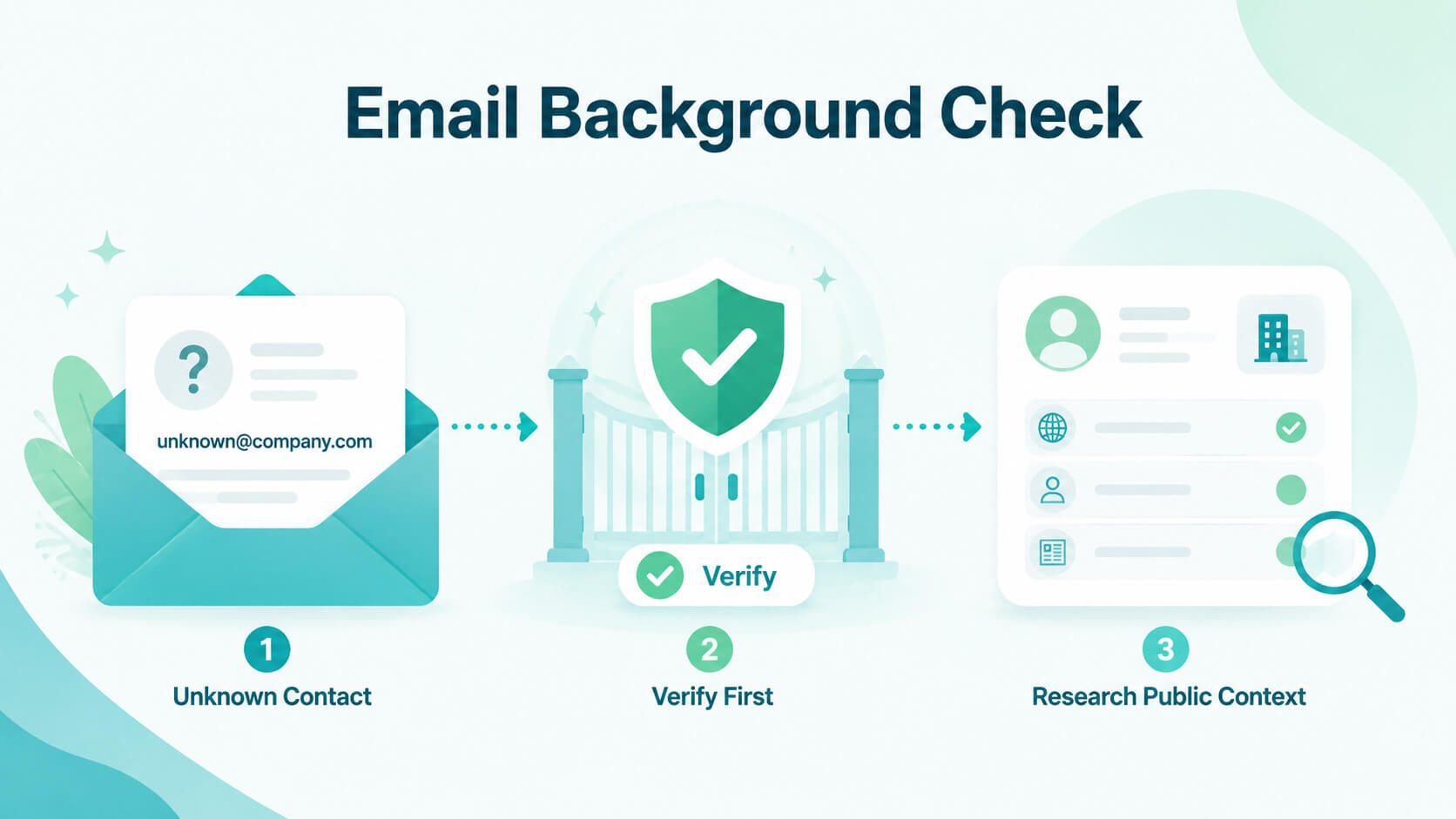
A reliable email background check follows a structured workflow rather than a single tool or quick search. The key idea is to move in the right order so you are not researching something that turns out to be invalid or misleading.
Each step builds on the previous one. You first confirm whether the email is worth trusting at a technical level, then you look at public signals, and only after that do you interpret any context or risk indicators with confidence. The steps below break this process down in a practical way.
Step 1: Verify the email address
Start by checking whether the email is valid, risky, or clearly unusable. This includes identifying disposable domains, spam traps, and inactive mailboxes. It also means handling catch-all domains, which require more advanced analysis to determine whether they are actually valid.
This step acts as a gatekeeper. If the email is invalid, the process stops. If it is valid but risky, it may require extra caution. For B2B teams, this is where tools like Allegrow are positioned. They provide conclusive “valid” or “invalid” statuses, even for traditionally ambiguous cases like catch-all domains and enterprise email systems protected by tools such as Mimecast or Barracuda.
Step 2: Search public web and profile signals
Once the email is verified, the next step is to look for public traces. This typically involves searching for the email address in search engines and checking professional platforms such as LinkedIn, company websites, or author bios. In some cases, the email may appear in press releases, conference pages, or open-source contributions.
The goal here is not to dig deeply into personal information. It is to confirm whether the email connects to a real professional identity or organization. Responsible use is key. Stick to publicly available information and avoid invasive or speculative conclusions.
Step 3: Review domain trust and red flags
The domain attached to an email often tells a story. A custom domain that matches a known company is usually a positive signal. Free email providers are not inherently bad, but they require more scrutiny in business contexts. Disposable domains or suspicious variants are strong red flags.
Other signals include mismatched naming patterns, unusual spelling variations, or domains that imitate legitimate companies. Catch-all domains also require careful interpretation, as they can accept all emails regardless of whether the specific mailbox exists.
This step is about pattern recognition. You are looking for consistency between the email, the domain, and the broader context you uncovered in earlier steps.
When businesses use an email background check
Email background checks are not tied to a single department or use case. They appear across different business workflows wherever teams need to make fast, low-friction trust decisions about an unknown contact. The common thread is uncertainty, where the email address becomes the first available signal to assess legitimacy before investing time or resources.
In sales and growth teams, they are often used to quickly evaluate inbound leads or outbound responses. In data-driven environments, they help assess whether contact data is reliable enough to be activated in campaigns or passed into a CRM. In partnerships or vendor relationships, they provide a lightweight way to sanity-check unfamiliar business contacts before moving forward.
While the depth of analysis varies by context, the purpose stays the same: reduce risk early without slowing down operations. This makes email-based checks a practical first layer of screening before deeper verification or formal due diligence is required.
Leads, vendors, freelancers, and unknown contacts
In sales and partnerships, teams often receive inbound contacts from unknown sources. An email background check helps determine whether the contact looks legitimate before investing time in outreach or negotiations. It is a lightweight screening process that reduces risk without slowing down operations.
For data providers, this process is even more critical. Poor-quality email data leads to high bounce rates, damaged sender reputation, and customer churn. Verifying and lightly vetting contacts ensures that downstream users receive accurate and usable data.
Job applicants and hiring-related use cases
In hiring, an email address can provide early context about a candidate, but it should always be treated as a lightweight signal rather than a decision-making tool. At most, it can help confirm whether a professional footprint exists or whether the email aligns with the information a candidate has already provided, such as their name, domain, or stated employer.
In some cases, an email may surface public profiles, portfolio pages, or mentions in professional directories. This can help recruiters build a basic sense of consistency across a candidate’s background. However, these signals are incomplete by nature and can vary widely depending on how visible or active someone is online.
This is also where the boundary between informal research and regulated screening becomes important. Email-based checks can support early-stage evaluation, but they should never be used as the sole basis for hiring decisions or substituted for formal background screening processes. When employment decisions are involved, structured checks and consent-based procedures are required to ensure fairness, accuracy, and compliance.
Legal and privacy limits
Email-based research sits in a sensitive space between informal due diligence and regulated background screening. It can be useful for gathering publicly available context, but it also intersects with privacy, employment law, and data protection rules depending on how the information is used.
Understanding where that boundary sits is essential because the same data point can be acceptable in one context and restricted in another. The key distinction is intent and impact. The more a process moves from “context gathering” into “decision influencing,” the more likely it is to fall under formal compliance requirements. The sections below explain where informal email research stops being sufficient and what employers need to keep in mind when it crosses into regulated territory.
When informal email research is not enough
Informal email research works well for early signals, but it falls short when decisions require certainty. Hiring, fraud checks, compliance decisions, or financial approvals all need verified identity, not inferred or publicly available information.
In these cases, an email can only support the process. It may highlight useful context or inconsistencies, but it cannot confirm who someone is or whether they meet formal requirements.
That is why higher-stakes decisions rely on structured, consent-based screening methods. Email-based insights can still help, but only as supporting context rather than proof. The gap between what a contact presents and what formal screening finds is larger than most teams expect: 46% of background screening verifications have identified discrepancies between information provided by applicants and what structured checks actually revealed — the kind of gap that email-based research cannot surface on its own.
What employers need to know before using background information
Employers in the United States must follow the Fair Credit Reporting Act (FCRA) when using third-party background reports. This includes obtaining consent, providing disclosures, and allowing candidates to dispute findings.
Additionally, the Equal Employment Opportunity Commission (EEOC) emphasizes that background checks must be applied consistently and without discrimination.
But even outside the U.S., similar principles apply under data protection laws such as GDPR. The key takeaway is simple: public research is generally allowed, but formal screening carries legal obligations.
Best tools and methods for an email background check
An effective email background check is not about finding a single all-in-one tool. It works best as a layered process, where different categories of tools each handle a specific part of the workflow. This reduces false assumptions early and improves the quality of any conclusions you draw later.
The most reliable setups follow a simple structure: verify first, research context second, and use formal screening only when the situation demands it. Each layer has a distinct role, and mixing them up is where most errors happen.
Verification tools, public research tools, and formal screening tools
Verification tools form the foundation of the process. Their role is to confirm whether an email address is technically valid and worth further attention. In B2B environments, this becomes especially important due to complex infrastructure such as catch-all domains, secure email gateways, and enterprise mail systems that can obscure simple validity checks. Tools like Allegrow are designed for this layer, helping teams separate real, usable inboxes from risky or inconclusive records at scale.
Public research tools come next and are focused on context rather than validity. These include search engines, professional networks, and company directories that can help connect an email address to a real-world identity or organization. At this stage, the goal is to understand whether the email appears in legitimate, consistent contexts across the web, not to verify its deliverability or technical status.
Formal screening tools sit at the final layer and are used only when decisions require verified identity and legal compliance. These systems rely on regulated data sources and structured processes that go beyond public signals or technical checks. They are typically required in hiring, financial, or compliance-heavy workflows where accuracy and accountability are mandatory.
Each category serves a different purpose, and they are most effective when used in sequence. Starting with verification prevents wasted research on invalid data, while skipping formal requirements in high-stakes decisions can create compliance and accuracy risks.
Conclusion
An email background check is a useful way to gather context, but it is not proof of identity. It can surface signals about legitimacy, affiliation, and risk, but it cannot replace formal background screening.
The most effective workflow is straightforward. Start by verifying the email to ensure it is real and valid. Then, explore the public context to understand who or what is behind it. Finally, escalate to formal screening only when the situation requires certainty and compliance.
For teams working with high volumes of B2B contacts, the first step is the most critical. Without accurate verification, everything that follows becomes unreliable.
If you want to test this approach in practice, start Allegrow’s 14-day free trial, and verify up to 1,000 contacts, including catch-all and enterprise emails, with clear “valid” or “invalid” outcomes. You can upload a dataset, identify risky addresses, and focus your research only on contacts that matter.
Frequently asked questions about email background checks
Is an email background check the same as email verification?
No, email verification checks whether an address is valid and capable of receiving messages. An email background check looks at the context around that address, such as public profiles and domain signals.
Can you identify someone from an email address alone?
Not with certainty. An email can surface clues like public profiles, company links, or naming patterns, but these are indirect and not always reliable. It cannot definitively prove identity, so it should be treated as one signal among many rather than a standalone identifier.
Is an email background check legal?
In many low-risk cases, informal research based on publicly available information may be lawful, but legality still depends on how the information is collected, used, and the jurisdiction involved. If the information is used for employment decisions or comes through third-party background reporting, legal frameworks such as the FCRA and EEOC guidance may apply, and in other jurisdictions data-protection laws such as GDPR can also matter.