Choosing an email verification tool sounds simple until your bounce rate spikes and your domain reputation takes a hit. At that point, “good enough” verification can quickly become expensive. If you’re researching Bouncify, you’re likely asking a practical question: will it reliably reduce bounces and protect deliverability, or is it worth switching to something built for higher-stakes B2B workflows?
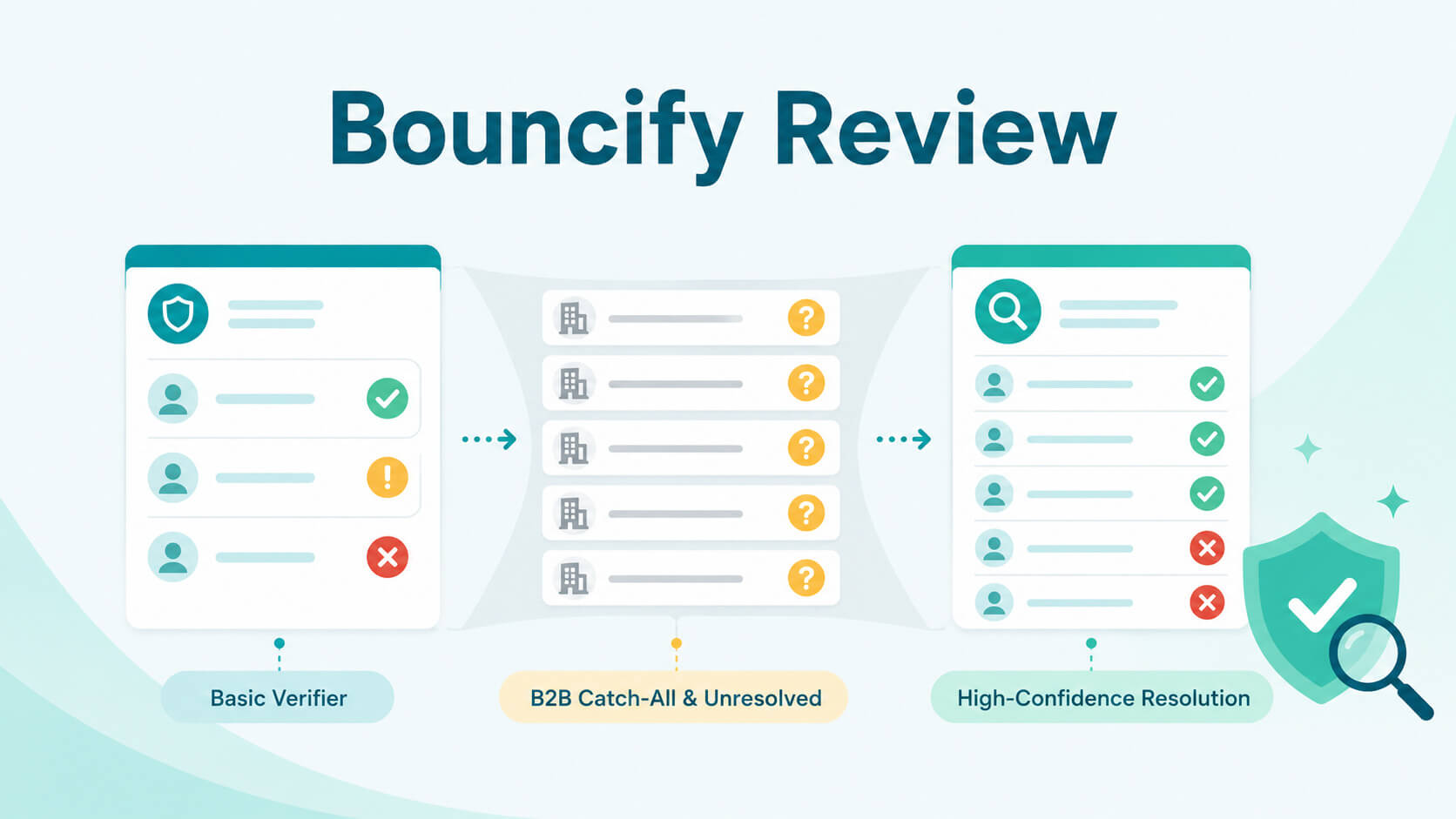
This Bouncify review walks through what the tool does, who it’s best for, how its verification works at a high level, pricing considerations, strengths and limitations, and what real users say. We’ll also compare Allegrow vs Bouncify and review the top alternatives, with a specific focus on B2B and enterprise-heavy datasets. The goal here is simple: help you decide whether Bouncify reduces enough risk for your use case, or whether you need a higher-confidence verifier. Spoiler alert! In our 10,000-record catch-all benchmark across 251 enterprise domains, Bouncify left 95.6% of records as Unknown/Catch-all and surfaced only 4.4% of the real contacts in the dataset, 22 out of 500. That is a concrete illustration of where basic verification reaches its ceiling on B2B data.
TL;DR: Bouncify can be a solid option for small-to-mid teams doing periodic B2C list cleaning when the primary goal is reducing obvious hard bounces. But if you work with enterprise-heavy B2B data, catch-all domains, or need verification embedded into production workflows, ambiguity becomes the real problem. In our catch-all benchmark (10,000 records across 251 enterprise catch-all domains), Bouncify found 4.4% of real contacts (22/500), returned Unknown/Catch-all for 95.6% of the dataset, and produced a 0% false positive rate estimate (1 of 5,000 fictional addresses). Allegrow found 98.2% of real contacts (491/500) and kept Unknown/Catch-all to 2.0% on the same data. If your workflow depends on clear decisions (send, suppress, or enrich) rather than large “unknown” buckets, you’ll likely want a higher-confidence verifier like Allegrow.
What is Bouncify used for?
Bouncify is an email verification tool designed to reduce invalid email addresses and hard bounces before you send campaigns or import data into your CRM. In practical terms, it checks email addresses in bulk or via API to determine whether they are valid, invalid, or risky.
The outcome most teams care about is fewer hard bounces. When you reduce hard bounces, you improve your sender reputation with providers like Gmail and Microsoft, which in turn lowers the risk of spam filtering. Hard bounces are a negative signal, and consistently high bounce rates can damage your domain’s “credit score” in the eyes of mailbox providers.
Verification also improves internal efficiency. By removing invalid or low-quality addresses, you avoid wasting sales touches on dead inboxes. That leads to a cleaner CRM and more reliable outreach metrics.
Who is Bouncify best for?
Bouncify is generally best suited for small-to-mid-sized teams performing periodic list cleaning. If you run occasional bulk scrubs before campaigns and want a straightforward verification workflow without complex governance or customization, it can be sufficient.
It fits teams that do not have heavy enterprise datasets or large volumes of catch-all domains. In these cases, the main goal is basic hygiene: remove obvious invalid emails and reduce bounce rates before sending.
However, if your dataset is enterprise-heavy, contains a high percentage of catch-all domains, or if borderline decisions materially affect pipeline quality, you may need a verifier with more advanced classification logic. In B2B, especially when targeting large organizations, catch-all behavior and secure email gateways can significantly complicate verification outcomes.
Why people look for a Bouncify alternative
Teams usually start searching for a Bouncify alternative when confidence drops. That often happens in two scenarios: valid emails still bounce, or too many legitimate leads are flagged as risky or unknown.
Corporate domains frequently use catch-all configurations, where the server accepts all incoming emails at the SMTP level. This makes simple verification checks less conclusive. If a tool returns too many “unknown” or misclassifies valid executive inboxes, sales teams don’t know whether to send or suppress a contact.
Workflow friction is another trigger. When verification shifts from occasional bulk cleaning to an always-on process embedded in your CRM or data pipeline, API reliability, bulk speed, exports, and integration stability matter more. A tool that works fine for one-off uploads may struggle when embedded in production systems.
To make the catch-all verification tradeoff measurable, here’s the benchmark method and results in one place.
Catch-all verification benchmark: Bouncify vs Allegrow (10,000 records)
Catch-all domains are designed to hide mailbox-level truth. A server can accept mail for any address on a domain while refusing to confirm whether a specific inbox exists. That’s why many tools collapse into Unknown/Catch-all outcomes on corporate data.
To make this measurable, we ran a controlled benchmark across 10,000 emails on 251 enterprise catch-all domains. The dataset included two cohorts:
- Real contact permutations: roughly 10 common permutations per professional (firstname.lastname@, flastname@, f.lastname@, etc.) for 500 verified professionals, totaling 5,000 records
- Fictional emails: 5,000 obviously fictional addresses on the same domains. Any tool marking these as “valid” is making an error, which is what the false positive estimate captures.
Here’s what we tracked:
- Real contacts found (out of 500): Of 500 verified professionals, how many had at least one permutation marked valid?
- False positive rate estimate (fictional-only, out of 5,000): Of fictional emails, what % were incorrectly marked valid?
- % Unknown/Catch-all (out of 10,000): How much of the dataset stayed unresolved?
What this means in practice: the core issue here isn’t false positives. Bouncify’s false positive rate is very low, though that is partly a function of how little it resolves: a tool that reaches a decision on roughly 4% of a dataset has very few opportunities to be wrong. The issue is resolution. When 95.6% of a catch-all-heavy dataset comes back as Unknown/Catch-all and only 22 of 500 real contacts surface, teams either drop most of the list or push the decision downstream into manual rules and exceptions. Allegrow resolved all but 2.0% of the same records and surfaced 491 of the 500 real contacts.
Bouncify features and how verification works
Like most verification platforms, Bouncify performs several layers of checks. According to third-party reviews such as Orbit Publishers and CompareCamp, it includes syntax validation, domain and DNS check, and SMTP handshakes.
The outputs are usually grouped into categories such as valid, invalid, risky, or unknown. Valid addresses are considered deliverable. Invalid addresses are expected to hard bounce. Risky or unknown addresses often include catch-all domains, role-based inboxes, or situations where the server response is inconclusive.
For buyers, the key question is what to do with each category. Most teams will send confidently to valid addresses, suppress invalid ones, and treat risky or unknown addresses with caution. That may involve lowering send volume, segmenting them into separate campaigns, or suppressing them entirely.
Operationally, Bouncify offers bulk uploads through its interface and API access for integration into applications and workflows. For occasional scrubs, the upload-export workflow is often enough. For always-on verification in forms, CRMs, or enrichment pipelines, API reliability becomes more important.
Bouncify pricing and limits
Bouncify’s public pricing is built primarily around pay-as-you-go verification credits, with no monthly subscription required on that model and unused credits that do not expire. Its documentation also references subscription plans, so buyers should confirm which pricing structure fits their workflow before purchasing. This is common in the industry and aligns cost with usage volume.
At first glance, buyers compare the cost per email, with Bouncify offering plans that start at $ 0.003 per email verification. However, a more accurate lens is the cost per avoided bounce plus the cost per saved good lead. If a tool is inexpensive but misclassifies valid enterprise emails as risky, the hidden cost is lost pipeline. If it lets too many invalid addresses through, the hidden cost is deliverability damage.
For small datasets, the difference between vendors may feel marginal. At scale, however, especially when verifying millions of records or running API calls in real time, pricing structures and volume tiers can significantly affect the total cost of ownership.
The real risk is false economy. The cheapest verifier can become the most expensive if it underperforms on catch-all or enterprise-heavy lists. In B2B, that nuance often outweighs minor price differences per thousand emails.
Pros and cons to know before you buy
Based on publicly available reviews and third-party summaries, Bouncify is often praised for being straightforward and easy to use. Reviewers describe it as simple to set up and suitable for teams that want a no-frills verification tool.
Users also note the availability of bulk verification and API functionality, which makes it usable beyond purely manual uploads. For smaller teams, this combination of simplicity and functionality is often enough.
On the other hand, as with many verifiers, questions tend to revolve around output confidence and edge cases. Catch-all verification, risky and unknown classifications, and performance on corporate domains are areas buyers should validate carefully in their own datasets. Reviews on G2 also reflect mixed experiences, with some users highlighting positive usability and others noting areas for improvement.
Before buying, ask direct questions about how the tool handles catch-all domains, secure email gateways, and high-volume API usage. If these factors materially affect your business, they should be part of your evaluation criteria, not an afterthought.
What real users say about Bouncify
Reviews provide helpful context beyond feature lists and marketing claims. They show how the tool performs in real-world workflows, under real constraints, with actual campaign pressure behind it.
For email verification specifically, reviews tend to surface themes around classification trust, handling of catch-all domains, API reliability, bulk speed, and support responsiveness.
What users consistently like
On G2, users frequently mention ease of use and straightforward workflows as positive aspects. The platform is often described as accessible for teams that want to clean lists without heavy configuration. For smaller marketing or sales teams, that simplicity reduces friction and shortens the time between upload and actionable results.
Reviewers also highlight its bulk processing capabilities and general usability for routine verification tasks. For periodic list scrubbing before a campaign launch or CRM import, the upload-and-export workflow meets expectations. In other words, for standard hygiene workflows aimed at removing obvious invalid addresses and reducing bounce rates, many users find the experience smooth and practical.
What users consistently dislike
Some users raise concerns around verification accuracy in edge cases, which is common across many verification platforms. Others note that while the tool works well for basic cleaning, more advanced needs may require deeper evaluation.
As always, it is important to interpret reviews in context. A small business running modest campaigns may find it fully sufficient. A data provider verifying hundreds of millions of B2B emails via API may experience very different constraints.
The 3 best Bouncify alternatives
If Bouncify doesn’t fully meet your requirements, it usually means your verification needs are more complex than basic list cleaning. That could involve enterprise-heavy B2B data, a high percentage of catch-all domains, API-driven workflows, or simply a lower tolerance for misclassification risk.
In those cases, it makes sense to evaluate alternatives through the lens of outcomes rather than feature counts. The tools below are commonly considered by buyers who need stronger classification confidence, smoother bulk workflows, or more reliable automation at scale.
Allegrow
Best for: B2B teams and data providers where catch-all and enterprise domains materially affect outcomes, and you need dependable controls and workflow stability.
Allegrow is built specifically for B2B verification realities. Instead of stopping at basic SMTP checks, it runs triple verification: syntax checks, SMTP and MX validation, and proprietary behavioral signals. This approach is designed to reduce “unknown” classifications and replace them with conclusive, valid or invalid statuses where possible. In the benchmark we mentioned previously, Allegrow found 491 of 500 real contacts and kept Unknown/Catch-all to 2.0%, compared to Bouncify at 22 of 500 real contacts found and 95.6% Unknown/Catch-all.
For enterprise domains protected by secure email gateways like Barracuda or Mimecast, Allegrow’s infrastructure is designed to reduce false positives that legacy tools often generate. It also includes primary executive inbox detection, filtering out secondary aliases so teams reach the active decision-maker rather than an unmonitored mailbox.
For data providers, the API is capable of processing hundreds of millions of requests daily, with customizable verification mixes and support for synchronous or asynchronous processing. For GTM teams, Allegrow’s Scale Plus plan emphasizes unlimited verification for core GTM workflows, which reduces the credit friction that can make routine CRM hygiene and list cleaning harder to operationalize.
Allegrow is SOC 2-certified, GDPR-compliant, and offers enterprise-grade security controls, including SSO and DPAs.
Bouncer
Click here to read a full in-depth review of UseBouncer.
Best for: teams that want a straightforward B2C verification product and a clean workflow for routine list cleaning.
Bouncer is frequently positioned as a user-friendly verification tool with solid bulk workflows and integrations. It is often evaluated by teams seeking a balance between usability and verification depth, without the complexity that can come with more enterprise-focused platforms. For teams that primarily run periodic list cleaning before campaigns, this simplicity can make it easy to adopt and operationalize quickly.
From a workflow perspective, Bouncer is designed to keep the process intuitive. Users can upload lists, review categorized results, and export cleaned data without needing to configure advanced rules or validation layers. This makes it particularly appealing for marketing and sales teams that want to move quickly from data cleaning to campaign execution.
In terms of verification, Bouncer performs standard checks such as syntax validation, domain and DNS verification, and SMTP-level mailbox probing. Like most tools in this category, it classifies emails into categories like valid, invalid, and risky. For many teams, this level of classification is sufficient, but performance on catch-all domains and more complex B2B environments should be validated with real data.
NeverBounce
Click here to read a full in-depth review of NeverBounce.
Best for: teams cleaning large lists fast in permission-based marketing or B2C contexts.
NeverBounce is commonly chosen for bulk-first workflows and large list cleaning. It is often associated with fast processing speeds and the ability to handle large datasets efficiently, making it a common option for teams working with significant volumes of permission-based email data.
The platform is typically used in scenarios where speed and scale are the primary priorities. Marketing teams running large campaigns, especially in B2C environments, often rely on tools like NeverBounce to clean lists quickly before sending. Its integrations also make it easier to plug into existing marketing stacks and automate parts of the verification process.
From a verification standpoint, NeverBounce uses standard industry methods such as syntax checks, domain validation, and SMTP-level checks to classify emails. For large, relatively clean datasets, this approach can effectively remove invalid addresses and reduce bounce rates at scale. However, like many bulk-focused tools, the nuance of classification becomes more important when dealing with B2B data.
Bouncify vs Allegrow: which is better for B2B verification?
The comparison should start with criteria, not features. The most important factors for B2B verification are a catch-all classification approach, enterprise mailbox realities, handling of risky or unknown results, API reliability, and governance controls.
The difference between the two shows up fastest on catch-all domains. In our benchmark, Bouncify returned Unknown/Catch-all for 95.6% of records and found 22 of 500 real contacts, while Allegrow kept Unknown/Catch-all to 2.0% and found 491 of 500 real contacts. That’s the practical gap between “list cleaning” and high-confidence B2B verification.
Bouncify can be good enough for smaller teams doing occasional scrubs with relatively low enterprise and catch-all exposure. If your list is straightforward and you are not embedding verification deeply into workflows, it may meet your needs.
Allegrow is generally the safer default when verification quality directly impacts deliverability and downstream outreach performance. Its conclusive catch-all verification, advanced risk detection, primary inbox identification, and managed quality IPs are designed for B2B complexity. For data providers and high-scale API users, customization and volume capacity also matter significantly.
The decision comes down to risk tolerance. If misclassifying valid executive inboxes or allowing risky addresses through would materially impact revenue or reputation, higher-confidence verification becomes an investment rather than a cost.
Conclusion
Email verification is about risk reduction. The best tool is not the one with the lowest cost per credit, but the one that reduces hard bounces without discarding good B2B leads, especially in catch-all and enterprise-heavy environments.
Bouncify can serve small-to-mid teams looking for straightforward list cleaning. For B2B organizations, data providers, and GTM teams operating at scale, the stakes are often higher. In those cases, verification quality, conclusive classifications, API reliability, and security controls become central.
If your outreach performance, sender reputation, or customer trust depends on accurate B2B verification, the next logical step is to test at scale. Start a 14-day free trial with Allegrow and verify up to 1,000 B2B addresses, including catch-all domains, with conclusive valid or invalid statuses.
FAQs about Bouncify
Is Bouncify a good email verifier?
Bouncify can be sufficient for basic list hygiene and periodic bulk cleaning. If your dataset has limited enterprise complexity and you mainly want to reduce obvious hard bounces, it may perform well. If you work with enterprise-heavy B2B lists or rely on high-confidence verification for deliverability and pipeline accuracy, however, Bouncify is not the best tool for you.
How accurate is Bouncify email verification?
Accuracy in verification means balancing false positives and false negatives, that is, marking an invalid email as valid or a valid email as risky or invalid. No tool achieves perfect accuracy because server behavior and catch-all configurations introduce uncertainty. That’s why the practical approach is to test the tool on your own dataset and compare bounce outcomes and classification patterns.
Does Bouncify verify catch-all domains reliably?
Catch-all domains accept all emails at the server level, which makes verification inherently more complex. Bouncify often classifies these as risky or unknown. Operationally, teams often segment catch-all addresses, send at lower volumes, and monitor engagement closely. If catch-all domains represent a significant share of your B2B data, consider a verifier that uses additional proprietary signals to move beyond basic SMTP responses. In our benchmark across 251 enterprise catch-all domains, Bouncify returned Unknown/Catch-all for 95.6% of 10,000 records and surfaced 22 of 500 real contacts, compared to Allegrow's 2.0% unresolved and 491 of 500 real contacts found on the same data.
Does Bouncify have an email verification API?
Yes, it offers API access for integrations, allowing teams to connect it to forms, CRMs, or data pipelines. When evaluating any API, validate latency, uptime, rate limits, and how the system behaves under sustained high-volume usage. For data providers processing millions of records, these factors are as important as classification accuracy.
What is the best Bouncify alternative for B2B lists?
The best alternative depends on your dataset and risk tolerance. For B2B teams and data providers dealing with enterprise and catch-all-heavy lists, Allegrow is typically the strongest option because of its conclusive classification approach, advanced risk detection, and scalable API.